
 Adedokun Waliyu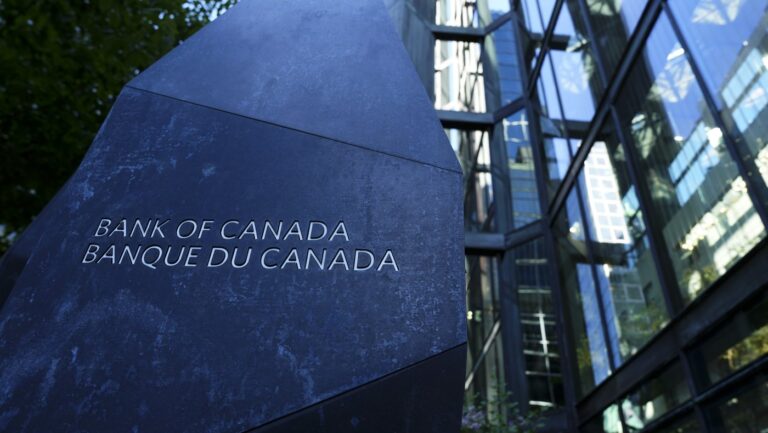
Bank of Canada building in Ottawa on Tuesday, June 9, 2026. THE CANADIAN PRESS/Sean Kilpatrick
The Bank of Canada held its benchmark interest rate steady for a fifth consecutive decision on Wednesday as it tries to support a turbulent economy without letting prices rise unchecked.
The central bank’s policy rate remains at 2.25 per cent after the hold, which was widely expected by economists.
Bank of Canada governor Tiff Macklem said in prepared remarks that the economy was weaker than expected in the first quarter of the year as U.S. trade policy and the war in Iran spur geopolitical uncertainty. Global oil prices — driven higher by the Middle East conflict — are meanwhile staying higher than first thought in the central bank’s April forecast.
“Against this backdrop, the Canadian economy has remained soft and inflation has increased,” Macklem said.
Annual inflation rose to 2.8 per cent in April, in part because of the global energy shock. The Bank of Canada now expects inflation to hold around three per cent in the coming months before easing back toward the central bank’s two per cent target.
Macklem said there has so far been “limited evidence” that higher energy prices are passing through into broader inflationary pressures.
He said the Bank of Canada will keep looking through the short-term rise in inflation tied to the oil price shock. He also reiterated the central bank will act to prevent price pressures from becoming entrenched.
The central bank is mandated to keep a lid on inflation but also tries to support the economy in the face of headwinds like U.S. trade aggression.
Competing pressures like these put the central bank in a dilemma, Macklem said.
“Raising rates to dampen inflation could further slow the economy. Easing rates to support growth increases the risk that higher inflation becomes persistent,” he said.
“For now, holding the policy rate unchanged balances those risks.”
Statistics Canada reported a slight contraction in real gross domestic product over the first three months of the year – a 0.1 per cent annualized decline, coming off a 1.0 per cent drop in the fourth quarter of 2025.
Those consecutive drops triggered debates about a recession hitting Canada, though many economists have pushed back on that narrative, arguing the modest nature of the decline doesn’t meet the bar for a recession.
Macklem said that recent economic data, including a strong May jobs report, signals the economy could rebound in the second quarter of the year. He also noted the labour market has been volatile lately but looking through the “bumpiness” shows employment is fairly flat so far in 2026.
KPMG chief economist Ali Jaffery said in a media statement that the focus on recent economic weakness gave Macklem’s remarks a “dovish” tone — suggestive of looser monetary policy rather than any tightening.
Risks of persistent inflation seem low in the face of a soft economy, Jaffery argued.
“Even if the economy perks up in Q2 — which it likely will — there is a lot of room for non-inflationary growth when an economy is coming out of a hole like this,” he said.
CIBC senior economist Andrew Grantham said in a note to clients that Wednesday’s rate decision reflects a “very patient central bank” content to wait and see how the risks play out.
He said CIBC continues to expect no change to the policy rate in 2026 as the current rate level supports a modest recovery in the economy starting later this year.