
 Adedokun Waliyu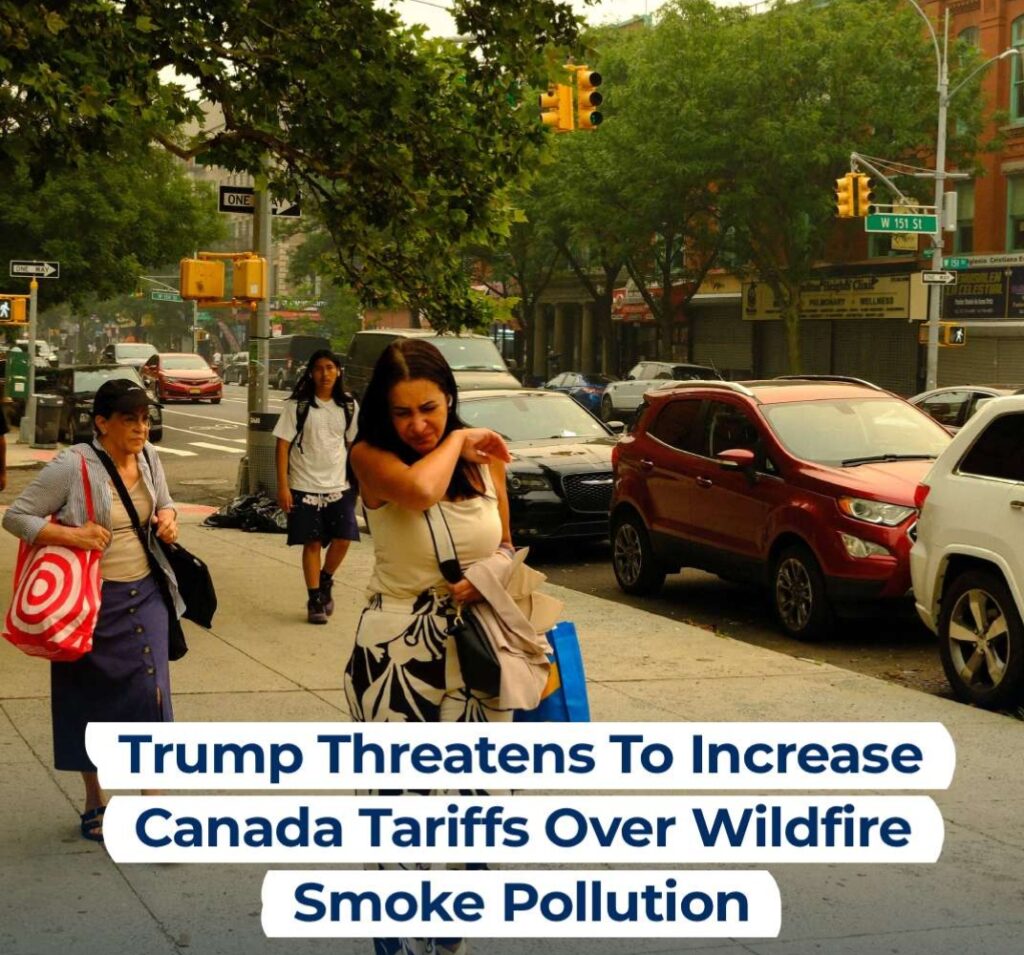
United States President Donald Trump has threatened to increase tariffs on Canadian imports, arguing that the cost of smoke pollution from Canada’s widespread wildfires should be borne by its northern neighbour.
Large plumes of smoke from wildfires burning across Canada and northern Minnesota have spread into the United States, triggering unhealthy air quality alerts in several states.
According to the Canadian Wildland Fire Information System, there were 937 active wildfires across Canada as of Saturday, with most of them burning out of control.
In a post on Truth Social, Trump accused Canada of failing to properly manage its forests, describing the situation as “wilful negligence” that has become an annual occurrence costing the United States billions of dollars.
He said the financial burden of the pollution should be reflected in higher tariffs already imposed on Canadian goods and announced plans to speak with Canadian Prime Minister Mark Carney about measures to address the problem.
Responding to the remarks, Canada’s Minister of Emergency Management, Eleanor Olszewski, said both countries remain in constant communication and have a long history of cooperating in wildfire suppression efforts.
She added that Canada has invested approximately 12 billion dollars in forest sustainability and wildfire prevention initiatives since 2020.
The wildfire smoke has significantly affected air quality across the United States. Detroit was ranked as the world’s most polluted city on Friday, while Washington, D.C., and Chicago also recorded unhealthy pollution levels. Health officials advised residents to avoid unnecessary outdoor activities.
The pollution has also raised concerns ahead of Sunday’s FIFA World Cup final in New Jersey. Although air quality in New York and New Jersey has improved slightly, authorities warned that smoke could become denser overnight into Saturday.
Tournament organisers said they are closely monitoring the situation.
Meteorologists from the US National Weather Service explained that shifting winds over the Great Lakes could push additional smoke into the northeastern United States, although weather forecasts suggest conditions may improve before the World Cup final.
Air quality experts also warned that smoke could continue drifting south depending on weekend weather patterns.
Across affected cities in the Midwest and Northeast, many residents have begun wearing face masks outdoors, while public libraries and train stations in New York are distributing masks free of charge.
Health experts warned that wildfire smoke contains extremely fine particles capable of penetrating deep into the lungs. They noted that the smoke may also contain harmful substances from burning buildings and other materials, making it potentially more toxic as it travels through the atmosphere.
Scientists say climate change is contributing to increasingly severe wildfire seasons by creating hotter temperatures and drier conditions, allowing fires to burn more intensely and for longer periods.
The wildfire situation remains critical in Canada, particularly in Ontario, where authorities continue battling dozens of major fires. Several remote communities have been evacuated, although no fatalities have been reported.
In neighbouring Minnesota, firefighters are also battling multiple active wildfires near the Canadian border, with weather officials warning that shifting winds, thunderstorms, and strong gusts could further complicate firefighting operations.