
 Segun Akanni, Toronto, Canada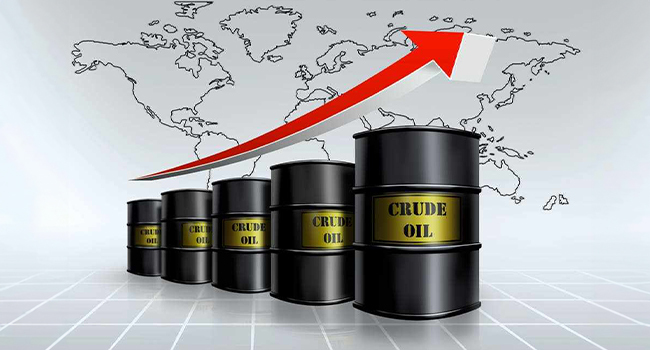
Oil prices jumped more than two per cent on Monday, with the Brent international benchmark rising above $90 a barrel following a fresh flare-up in the US-Iran war.
Stocks on Wall Street dipped and were mixed elsewhere as investors continued to react to hawkish comments from Federal Reserve chief Kevin Warsh.
After declining for most of the previous week, oil prices spiked again following reports that the United States had attacked Iranian rocket launchers on a small island in the Strait of Hormuz, marking its first strikes on Iran in a month.
The attack prompted Tehran to retaliate by hitting US military targets in Jordan.
President Donald Trump said the United States would respond to Iranian attacks on US targets in the Middle East.
The exchange came shortly after the US-Iran war reached the six-month mark, at a time when hostilities had been subsiding.
The latest developments revived concerns about the conflict in the Gulf, with attempts at peace talks appearing to make little progress. The Strait of Hormuz, through which about a fifth of global crude oil and gas normally passes, remains largely closed.
“For oil traders, the move is another reminder of how quickly the geopolitical premium can return,” said Quintex Intel’s Stephen Innes.
He added that although physical flows through the Strait of Hormuz had improved significantly from their worst levels, the latest military exchange showed how fragile that progress remained and how quickly concerns over shipping could return to the market.
Meanwhile, inflation remains stubbornly high, largely due to elevated energy costs, putting pressure on the US Federal Reserve to act.
Warsh’s recent comments have increased uncertainty over the possibility of an interest rate hike. In a speech at the Jackson Hole symposium of central bankers and economists in Wyoming, he described the current inflation rate of 3.7 percent, nearly double the Federal Reserve’s two-percent target, as concerning.
He also said he would be “hard-pressed” to describe current financial conditions as restrictive, which was widely interpreted as a possible indication that interest rate increases could be considered.
However, he stopped short of saying he would support a rate hike, stating that he was committed to discipline rather than a specific decision.
All three major US stock indexes fell as investor expectations for an interest rate increase in September increased.
The Dow Jones Industrial Average fell 0.5 percent as trading began in New York.
Briefing.com analyst Patrick O’Hare said there was a negative bias in the equity futures market, driven partly by the latest military exchanges between the United States and Iran and higher yields on US government debt.
Asian stock markets initially struggled, although some recovered as trading progressed, leaving some markets in positive territory while others remained slightly below their previous close.
In Europe, Paris stocks edged higher while Frankfurt declined. London markets were closed for a holiday.
Investors will now focus on key economic data expected over the next two weeks before the Federal Reserve makes its next decision. Jobs figures are expected this week, while the consumer price index will be released next week.
Key Market Figures
– Brent North Sea Crude: Up 2.5% at $90.26 per barrel
– West Texas Intermediate: Up 2.5% at $85.51 per barrel
– Dow Jones: Down 0.5% at 53,293.52 points
– S&P 500: Down 0.3% at 7,691.49
– Nasdaq Composite: Down 0.2% at 26,357.81
– FTSE 100: Closed for a holiday
– CAC 40: Up less than 0.1% at 8,407.64
– DAX 40: Down 0.7% at 26,387.02
– Nikkei 225: Down 0.1% at 66,311.93
– Hang Seng Index: Down 0.1% at 25,566.99
– Shanghai Composite: Up 0.9% at 3,986.30
– Euro/Dollar: Up at $1.1600 from $1.1586
– Pound/Dollar: Up at $1.3545 from $1.3538
– Euro/Pound: Up at 85.65 pence from 85.58 pence
– Dollar/Yen: Down at 159.81 yen from 160.07 yen