 Adedokun Waliyu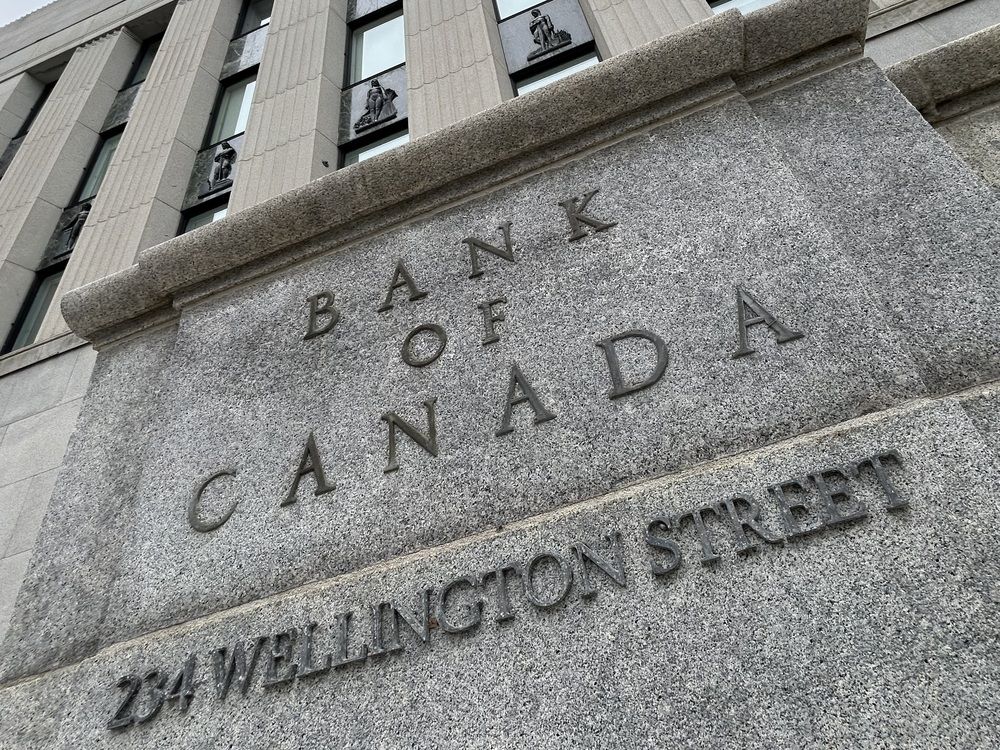
The Bank of Canada is expected to leave interest rates unchanged on Wednesday, continuing to look past the energy price shock that has squeezed consumers at the gas pump but so far not fuelled a broader surge in inflation.
Over the past two months, the conflict in the Middle East has pushed global oil prices sharply higher. Gasoline prices jumped 21 per cent in Canada in March, the largest one-month increase on record. That lifted annual headline inflation to 2.4 per cent from 1.8 per cent the previous month.
The central bank’s governing council is eyeing energy prices warily. But they’re not expected to make any sudden moves.
“You don’t want to jump too early and raise interest rates and lower growth, particularly when growth is already weak,” Governor Tiff Macklem told reporters on a call earlier this month. “On the other hand, you don’t want to be late and let inflation get a hold and become entrenched.”
The U.S. Federal Reserve also has a rate decision on Wednesday, where it is widely expected to leave its benchmark rate unchanged.
At the past BoC decision in March, Mr. Macklem and his team held the bank’s policy rate steady at 2.25 per cent and said they’d “look through” the oil price shock so long as it didn’t drive up other consumer prices or boost longer-term inflation expectations.
So far, inflation looks fairly well contained. While gasoline lifted headline inflation in March, the bank’s preferred core inflation measures, which capture underlying price trends in the economy, remained largely unchanged at just above the bank’s 2-per-cent target.
A lot is riding on the fragile U.S.-Iran ceasefire. Benchmark oil prices tumbled after the temporary truce was announced two weeks ago, with the price of a barrel of West Texas Intermediate crude dropping from US$112 to as low as US$84.
But prices have risen again over the past week as the U.S. and Iran have failed to make progress on talks to end the war and the Strait of Hormuz has remained effectively closed to shipping. On Friday, WTI was trading at around US$95 – compared with around US$65 when the war began.
The question for the Bank of Canada is two-fold: How long will oil prices remain high? And how long does it take for these elevated energy prices to feed through supply chains and push up other consumer prices?
“There’s the camp that thinks if the war were to end tomorrow, oil prices come back down, and we’re sort of back to the way we were before,” Jeremy Kronick, chief executive of the C.D. Howe Institute and chair of the think tank’s monetary policy council, said in an interview.
“There’s another camp that says, ‘Well, hold on. There’s going to be a lot more volatility in oil prices going forward, if Iran sees the Strait as leverage, even if the war itself ends. … [And] we were already experiencing food price inflation before the war, so now you have oil price increases and still have food inflation, and that drives people’s inflation expectations,’” Mr. Kronick said.
Whether a supply shock turns into a broader inflationary push depends to a significant degree on the state of the economy at the time. Companies have an easier time passing cost increases along to customers when demand is strong.
Recent economic data, including the latest retail sales numbers on Friday, have shown some resilience. But broadly speaking, Canadian economic growth remains stuck in low gear, with elevated unemployment and uncertainty about the future of the United States-Mexico-Canada trade agreement weighing on business confidence.
“The starting point for the economy going into this shock was not strong,” Nathan Janzen, assistant chief economist at Royal Bank of Canada, said in an interview. “And when the Bank of Canada looks forward, if the economy is underperforming its production potential, the implications are that that’s a broadly disinflationary backdrop. It means you don’t need higher interest rates in that kind of an environment.”
Financial markets are currently pricing between one and two quarter-point rate hikes from the Bank of Canada this year, beginning in October, according to Bloomberg data.
Most Bay Street analysts are less hawkish. A Reuters poll of 41 economists last week found that 80 per cent expected the Bank of Canada to leave interest rates unchanged this year.
With no one expecting movement this week, the focus will be on the bank’s quarterly Monetary Policy Report (MPR), which comes out Wednesday alongside the rate announcement. This will contain the bank’s updated forecast for inflation and economic growth, as well as its analysis of the forces shaping the Canadian economy.
In its last MPR in January, the bank projected the Canadian economy would grow by 1.1 per cent in 2026 and 1.5 per cent in 2027. In March, however, Mr. Macklem warned that risks to economic growth were now “tilted to the downside,” compared with the January forecast.
Because Canada is a major oil producer, its economy benefits in some ways from energy price shocks, which boost oil-company profits and fill government coffers with royalty revenues. On the flipside, consumer spending tends to be constrained by higher prices at the pump.
Economists will also be watching on Wednesday to see if the central bank changes its estimate of the “neutral rate” – something it reassesses every year in the spring MPR.
This is the bank’s estimate for an interest-rate level that neither constrains nor stimulates the economy. It’s an important input into monetary-policy models: If the policy rate is above neutral, it’s restrictive. If it’s below neutral, it’s stimulative.
The bank currently puts neutral somewhere between 2.25 per cent and 3.25 per cent.
Ali Jaffery, chief economist at KPMG Canada, said he doesn’t expect the central bank to adjust its neutral estimate this week. But he does think policymakers may be reassessing the number internally, given the forces weighing on Canada’s potential growth, from slower immigration to increased trade barriers with the United States.
“We won’t know that for some time, but in the equilibrium that we’re at right now, it seems that neutral is lower,” Mr. Jaffery said in an interview.
“In that instance, certainly you don’t want to be hiking [interest rates], because monetary policy may not be as much on the accommodative side as they’ve described it. It’s more firmly neutral. And so, you just keep it where it is,” he said.