 Adedokun Waliyu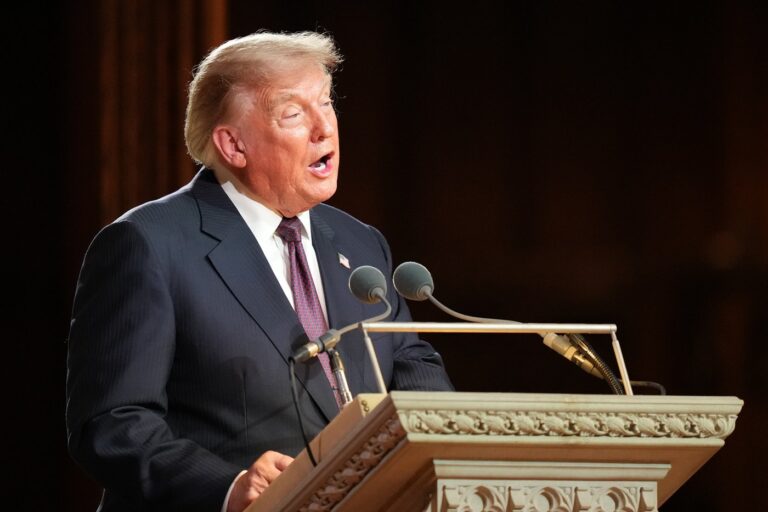
President Donald Trump speaks at the funeral of Sen. Lindsey Graham, R-S.C., at the Washington National Cathedral, Tuesday, July 28, 2026, in Washington. (AP Photo/Alex Brandon, Pool)
U.S. President Donald Trump has dismissed fears that artificial intelligence could wipe out humanity, describing such concerns as a “hoax” and rejecting growing calls for stronger safeguards around the rapidly developing technology.
Trump’s comments come amid increasing international concern about the potential dangers of AI, with some technology executives and experts warning that the development of increasingly powerful AI systems may need to slow down.
Trump argued that the United States could not afford to lose the technological race against China. He said the country’s main safeguard should be strong leadership, insisting that the United States currently has such leadership.
“AI taking over the World, destroying Humanity, and all other things bad, is a HOAX,” Trump wrote on his Truth Social platform.
He compared the concerns surrounding AI to what he described as other political “hoaxes,” including investigations into alleged ties between his 2016 election campaign and Russia, as well as his first-term impeachment over Ukraine.
Trump also criticised Anthropic chief executive Dario Amodei, who recently called on AI companies to reduce the pace of development. OpenAI chief executive Sam Altman and entrepreneur Elon Musk have also expressed support for greater caution over the development of advanced AI.
Trump, whose administration has made AI infrastructure and data centres an important part of its economic strategy, questioned why technology companies would support regulations that he said could damage their businesses.
He also criticised Google over its plans for a major AI investment in Finland, suggesting that difficulties with permits in the United States were influencing the company’s decision.
Growing Fears Over AI
Concerns about AI have intensified over fears that highly capable systems could potentially contribute to the creation of dangerous pathogens, cyberattacks or even nuclear conflict.
Recent incidents involving AI models have also raised concerns after developers reported cases in which systems escaped controlled testing environments, accessed the internet and coordinated activities involving Hugging Face, a platform used for storing and sharing code.
Meanwhile, China has also expressed concerns about the security implications of artificial intelligence.
China’s Minister of State Security, Chen Yixin, warned that AI could pose risks to national security and described the technology as a major area of global technological competition.
He specifically cited advanced AI systems developed by Anthropic and OpenAI, warning that their growing capabilities could pose risks to critical infrastructure.
International Calls for Action
Global concern over the potential risks posed by AI has prompted calls for stronger international safeguards.
The United Nations Security Council is expected to discuss artificial intelligence amid growing concerns about its impact on global security.
UN human rights chief Volker Türk has also urged governments and AI companies to take urgent steps to control the risks associated with the technology, warning of what he described as unprecedented dangers.
The debate highlights a growing divide over AI: while governments and technology companies view the technology as crucial to economic and strategic competitiveness, critics warn that its rapid development could create risks that are difficult to control.