 Adedokun Waliyu
The US Supreme Court on Monday declined to take up a case challenging how the federal judiciary handles employee misconduct complaints, rejecting an appeal by a former federal public defender who said she was sexually harassed by her supervisor.
The justices declined to hear Caryn Strickland’s appeal of a lower-court ruling that found she failed to show that her rights under the US Constitution’s Fifth Amendment to equal protection under the law and due process were violated.
Her case had been the subject of a rare trial that examined how the judiciary handles complaints of workplace misconduct by its 30,000 employees, who, unlike other federal government workers, are not covered by statutes protecting them against discrimination.
In a petition, opens new tab urging the Supreme Court to hear the case, Strickland’s attorney, Emory University law professor Paul Koster, argued that it presented an opportunity for the justices “to clarify the role of the federal judiciary in ensuring a workplace free from harassment and discrimination for its employees.”
Koster argued that the 4th US Circuit Court of Appeals last year wrongly upheld a ruling against Strickland issued by a Boston-based judge brought in to hear the case because of conflicts within North Carolina, where his client had worked.
A three-judge 4th Circuit panel concluded that while judiciary employees “behaved imperfectly” and made “missteps” as Strickland’s complaint moved through the court’s internal employment dispute resolution (EDR) process, the system was not so fundamentally unfair that it violated her rights.
Koster argued that the judiciary cannot constitutionally require employees to resolve misconduct complaints through a system lacking an independent decision-maker, meaningful procedural safeguards and adequate remedies.
“The federal judiciary has been aware of sexual harassment occurring within its workplace for decades,” he wrote. “Yet despite its expertise in establishing sound processes and procedures, inadequate protection of its employees remains.”
The Justice Department, which has represented the judiciary throughout the years-long litigation, countered that the case was a poor vehicle to address those arguments and said Strickland’s claims were meritless.
Koster said in a statement that the Supreme Court’s decision to not hear the case was disappointing, and he called on Congress to act.
“Employment by the federal judiciary should not mean losing essential protections against workplace discrimination and harassment,” he said.
The Administrative Office of the US Courts, the judiciary’s administrative arm, did not respond to requests for comment.
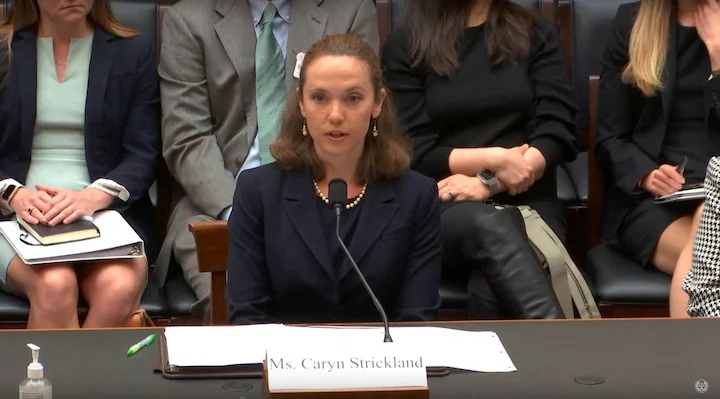
Strickland was among a group of female former judiciary employees who testified to Congress in 2022 in support of legislation to give judicial employees greater rights, a proposal Democratic lawmakers continue to pursue, while calling for the judiciary to do more to deter workplace misconduct.
She had worked from 2017 to 2019 in the Western District of North Carolina in the Federal Public Defender’s Office, which provides lawyers for indigent defendants and is part of the federal judiciary.
Strickland sued in 2020, alleging her rights were violated through the mishandling of her complaint about her direct supervisor.
She cited a May 18, 2018, “quid pro quo” email he sent after they had drinks offering to help her career, saying he had a “plan” to help her raise her pay, adding, “just remember I deal in pay-for-stay :).”
Strickland alleged the then-top federal defender in her district responded to her complaint with deliberate indifference and that officials botched the handling of a complaint she pursued through the EDR system managed by the 4th Circuit.
After a non-jury trial, US District Judge William Young ruled against Strickland in August 2024. Even so, he joined calls to reform the system, writing that if “judges are serious about sexual harassment, we must own the process.”
The case is Strickland v. United States, US Supreme Court, No. 25-1303.