
 Adedokun Waliyu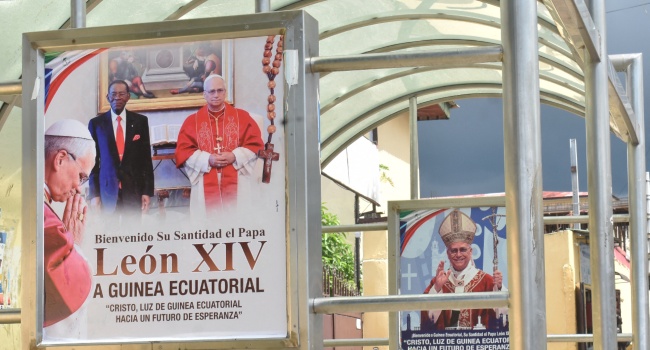
Pope Leo XIV has begun the final leg of his African tour with a visit to Equatorial Guinea, where his increasingly vocal defence of human rights is drawing attention in one of the continent’s most closed-off states.
After spending three days in Angola, the US-born pontiff arrived in the Central African nation, which has been ruled since 1979 by Teodoro Obiang Nguema Mbasogo, one of the world’s longest-serving non-monarch leaders.
He follows in the footsteps of Pope John Paul II, who became the first pope to visit Equatorial Guinea 40 years ago. The country, with a population of about two million people, is largely Catholic, a legacy of Spanish colonisation.
Throughout his African tour, the pope has spoken against tyranny and exploitation while promoting peace and social justice, adopting a more assertive tone than in the past. Attention is focused on whether he will maintain that stance during his visit, given the country’s record of authoritarian rule and human rights concerns.
Many opposition figures and independent media outlets from Equatorial Guinea operate in exile, particularly in Spain, amid allegations of repression, arbitrary detentions, and restrictions on public freedoms.
In Malabo, the former capital on Bioko Island, streets are lined with banners and portraits welcoming the pope, alongside flags of the Vatican and Equatorial Guinea. Church choirs are expected to perform hymns composed in his honour.
Residents have expressed hope that the visit will inspire unity and renewed religious commitment.
During his visit, the pope is scheduled to address government officials, diplomats, civil society groups, and cultural representatives. He will also travel to Mongomo to celebrate mass and meet students and teachers at a technology school named after Pope Francis.
The tour will continue to Bata, the country’s economic capital, where he will honour victims of a 2021 military camp explosion and visit inmates at a local prison.
The visit will conclude with a large mass at Malabo stadium, marking the end of his 11-day, 18,000-kilometre journey across Africa.