 Adedokun Waliyu
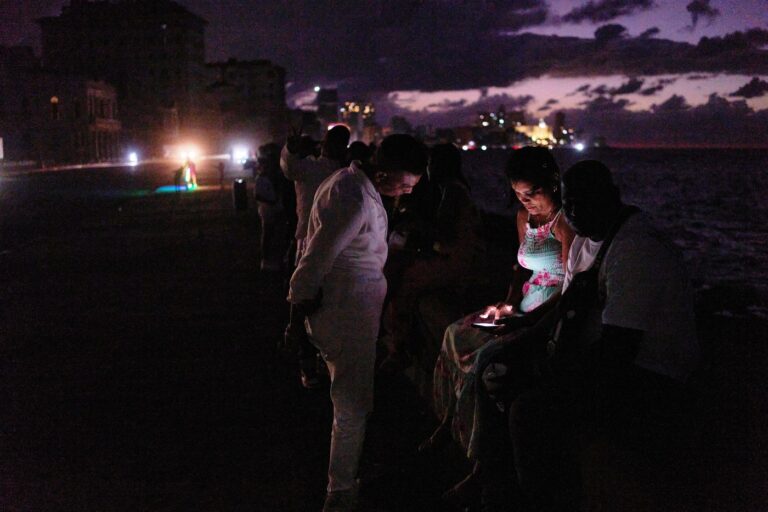
People spend the night in the dark on the Malecon during a blackout in Havana, Cuba, Saturday, March 21, 2026. (AP Photo/Ramon Espinosa)
Cuba began restoring its energy system on Sunday, a day after a nationwide collapse of the entire grid left millions of people in the dark for the third time this month.
Some 72,000 customers in the capital, among them five hospitals, had electricity again early Sunday, according to a report from the state-run Electric Union and the Ministry of Energy and Mines, but it’s only a fraction of Havana’s total population of approximately 2 million.
In Havana and provinces such as western Matanzas and eastern Holguin, local power microsystems were set up to supply the most vital centers. Residents in some areas of the capital told The Associated Press that power returned during the early morning hours.
Cuba is currently facing an unprecedented energy crisis. Its aging grid has drastically eroded in recent years, but the government has also blamed the outages on a U.S. energy blockade, after President Donald Trump in January warned of tariffs on any country that sells or provides oil to Cuba. His administration is demanding that Cuba release political prisoners and move toward political and economic liberalization in return for a lifting of sanctions. Trump also has raised the possibility of a “friendly takeover of Cuba.”
Another reason Cuba has been struggling with dwindling oil is the removal by the U.S. of Venezuela’s former President Nicolás Maduro, which halted critical petroleum shipments from the nation that had been a steadfast ally to Havana.
President Miguel Díaz-Canel has said the island has not received oil from foreign suppliers for three months. Cuba produces barely 40% of the fuel it needs to power its economy.
Daily blackouts have a significant impact on the population, whose lives are disrupted by reduced work hours, lack of electricity for cooking and damage to household appliances, among many other consequences.
“With the blackout and low voltage, my refrigerator broke — that was today. The day before yesterday, the voltage also dropped around 10 at night,” Suleydi Crespo, a 33-year-old woman with two small children, told AP on Saturday. “If there’s no electricity tomorrow, we won’t be able to get water.”
Residents also expressed exhaustion from the constant outages, whether nationwide or partial.
The Cuban Electric Union, which reports to the Ministry of Energy and Mines, reported that the total disconnection of the national energy system was caused by an unexpected shutdown of a generation unit at the Nuevitas thermoelectric plant in Camaguey province, without providing details on the specific cause of the failure.
The last nationwide blackout occurred on Monday. It took several days to restore power.
Saturday’s outage was the second in the past week and the third in March.
“We have to get used to continuing our usual routine. What else can we do? We have to try to survive. Get used to events, with or without electricity,” said Dagnay Alarcón, a 35-year-old vendor.
Authorities and Díaz-Canel himself have acknowledged the seriousness of the current energy situation. The Vice Minister of Energy and Mines Argelio Abad Vigo explained this week that the country has gone three months without receiving supplies of diesel, fuel oil, gasoline, aviation fuel or liquefied petroleum gas — all vital for the economy and power generation.
Fuel sales for vehicles are rationed, airlines have suspended flights or reduced frequencies many workplaces have reduced hours.
Trump has for months suggested Cuba’s government is on the verge of collapse. After a previous time Cuba’s electric grid collapsed, Trump told reporters he believed he’d soon have “the honor of taking Cuba.”
María Regla Cardoso, a housewife in Havana, said she isn’t interested in politics and that Cubans have to keep living.
“I leave everything in God’s hands. Whatever form the situation takes, we just have to face it.”