 Adedokun Waliyu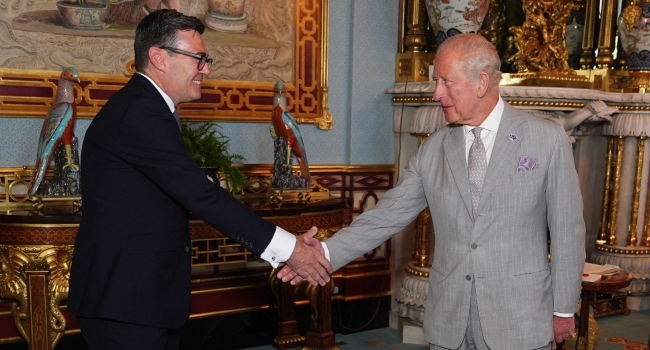
Andy Burnham officially became the Prime Minister of the United Kingdom on Monday after meeting King Charles III at Buckingham Palace, succeeding Keir Starmer as the country’s new leader.
The transition followed Starmer’s resignation, which was formally accepted by the King before Burnham was invited to form a new government. Burnham accepted the invitation, becoming the sixth British prime minister in the past ten years.
Before leaving Downing Street, Starmer defended his two years in office, saying his administration had made Britain a stronger and fairer nation.
“I am confident that Britain is now stronger and fairer than it was two years ago,” Starmer said in his farewell speech.
“I go with good grace, I go with a smile, and I go proud of everything that we have achieved.”
Burnham, 56, is expected to outline his government’s priorities in his first address as prime minister. His team said the speech will focus on restoring confidence in government, easing the cost-of-living crisis, promoting economic growth, and devolving more powers to regional communities.
He is also expected to announce key cabinet appointments, including the appointment of a new finance minister.
A former Mayor of Greater Manchester, Burnham emerged as Labour Party leader after Starmer stepped down. Party members viewed him as the strongest candidate to strengthen Labour’s position against Nigel Farage’s Reform UK Party.
Burnham acknowledged that the country faces significant economic and political challenges, including slow economic growth, rising government borrowing costs, increasing welfare spending, irregular migration, volatile energy prices linked to the US-Iran conflict, and uncertainties surrounding relations with the United States.
In a recent interview, he pledged to adopt a different economic strategy focused on early investment and intervention rather than spending heavily on addressing long-term failures.
He also promised immediate measures to help ease the cost-of-living pressures facing households across the country.
Burnham served as a Member of Parliament from 2001 to 2017 and held ministerial positions under former Prime Ministers Tony Blair and Gordon Brown. After leaving Parliament, he served as Mayor of Greater Manchester, where he built a reputation as a strong regional leader.
Although he has returned to Parliament only recently, Burnham has less than three years to deliver results before the next general election, expected in 2029, as opinion polls currently show Reform UK leading.
His first major policy decision was to cancel the nationwide digital identity scheme introduced by the previous government. According to his office, the funds allocated to the programme will instead be redirected toward measures aimed at reducing the cost-of-living burden on British families.