
 Adedokun Waliyu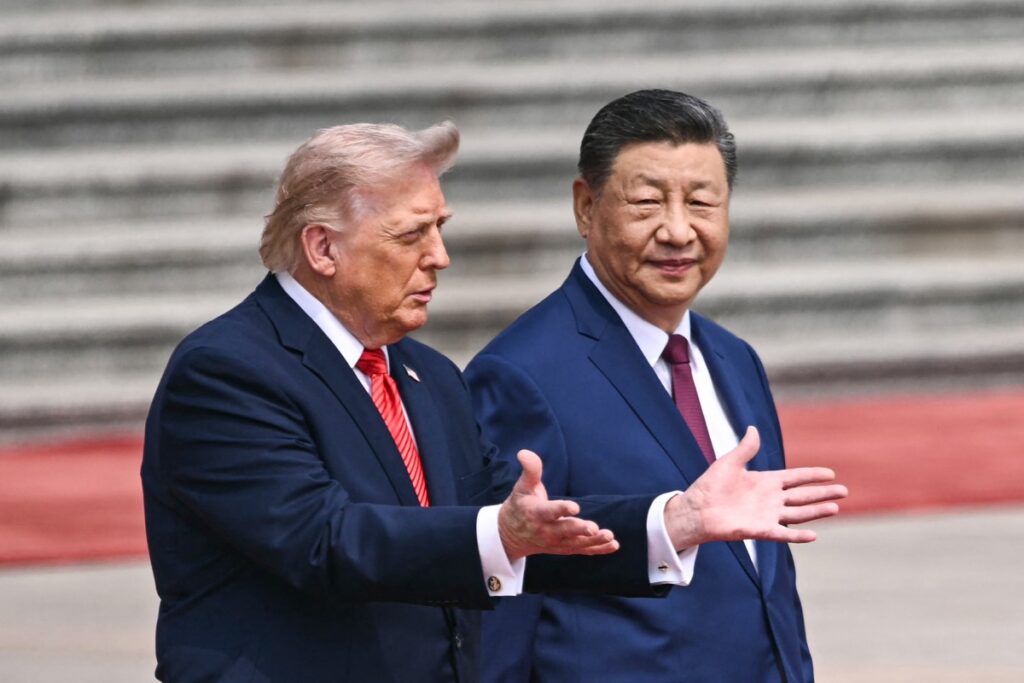
Chinese President Xi Jinping warned his US counterpart Donald Trump that missteps on Taiwan could push their two countries into “conflict”, as they met in Beijing at a major summit between the two powers.
Trump arrived in China praising Xi, calling him a “great leader” and “friend”, while predicting that both countries would have “a fantastic future together”.
Despite the warm reception, Xi stressed that the two nations “should be partners and not rivals”, while quickly raising the issue of Taiwan — which Beijing claims as its territory.
“The Taiwan question is the most important issue in China-US relations,” Xi said during the talks.
“If mishandled, the two nations could collide or even come into conflict, pushing the entire China-US relationship into a highly perilous situation,” he added.
Trump’s visit is the first by a US president to Beijing in nearly a decade. Xi welcomed him with a grand ceremony at the Great Hall of the People, featuring a military band, a 21-gun salute and cheering schoolchildren waving flags.
Trump appeared pleased with the reception and said the relationship between China and the United States “is going to be better than ever before”.
Xi, however, referred to the “Thucydides Trap”, an ancient Greek political theory warning about the danger of war when a rising power challenges an existing dominant power.
“Can China and the United States transcend the so-called ‘Thucydides Trap’ and forge a new paradigm for major-power relations?” Xi asked, adding that “cooperation benefits both sides, while confrontation harms both”.
Relations between the two countries have remained tense in recent years, especially over trade disputes and global political disagreements.
‘Blunt language’
Taiwan remains one of the most sensitive issues between Washington and Beijing.
Although the United States officially recognises only Beijing, American law requires the US to provide Taiwan with defensive weapons.
China has vowed to reclaim Taiwan and has not ruled out using force, while increasing military pressure around the island in recent years.
After Xi’s remarks, Taiwan described China as the “sole risk” to regional peace and said the United States had repeatedly shown strong support for Taiwan.
Trump had earlier stated that he planned to discuss US arms sales to Taiwan with Xi, marking a shift from Washington’s long-standing policy of not consulting Beijing on such matters.
The White House later described the initial talks as “good”, though Taiwan was not mentioned in its summary.
Analysts noted that Xi’s direct warning was unusual in tone. Adam Ni, editor of the China Neican newsletter, said such “blunt language” is rare coming directly from the Chinese leader.
Chong Ja Ian of the National University of Singapore said China appears to be seeking concessions from the United States on Taiwan and may believe Trump could be persuaded.
Iran Overshadows Meeting
The two leaders also discussed the conflict involving Iran.
According to the White House, both sides agreed that the Strait of Hormuz should remain open to ensure the free flow of energy supplies.
Xi reportedly stated that China opposes the militarisation of the strategic waterway and any attempt to charge for its use.
Economic cooperation was also discussed, with Trump hoping for business agreements involving agriculture, aircraft and other sectors.
Several business executives, including Nvidia CEO Jensen Huang and Tesla CEO Elon Musk, attended part of the meeting.
Xi told the business delegation that China’s “doors to the outside world will open wider and wider”.
The leaders also discussed trade talks held earlier in South Korea, which Xi described as “generally balanced and positive”. Both countries are expected to discuss extending the one-year tariff truce reached during their previous meeting in October.
The Ukraine conflict and North Korea were also discussed during the summit.
Away from formal negotiations, Trump and Xi visited the Temple of Heaven, a historic site where Chinese emperors once prayed for good harvests, before returning later for a state banquet.