
 Adedokun Waliyu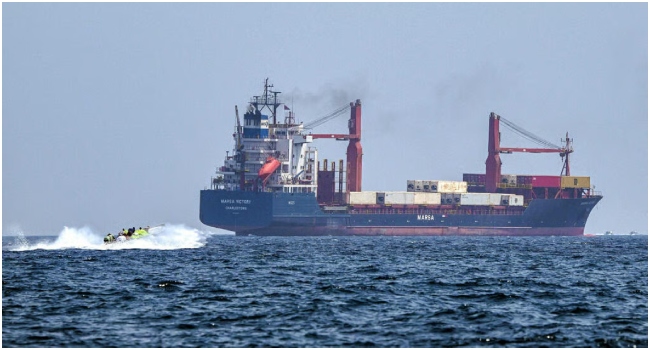
The US military said it would begin a blockade of all Iranian ports on Monday, after talks between the warring sides in Pakistan collapsed, with President Donald Trump blaming Iran’s refusal to abandon its nuclear ambitions.
Trump had earlier announced plans to blockade the strategic Strait of Hormuz trading route, demanding Tehran fully reopen it after US Vice President JD Vance left negotiations with an Iranian delegation in Islamabad.
The breakdown in talks dashed global hopes for a permanent end to the war, which has killed thousands and disrupted the global economy since it began in late February.
Mediator Pakistan said it would continue facilitating dialogue and urged both sides to respect the fragile two-week ceasefire reached earlier.
“The blockade will be enforced impartially against vessels of all nations entering or departing Iranian ports and coastal areas,” US Central Command said, adding it would begin at 1400 GMT on Monday.
However, US forces said they would not interfere with ships transiting the Strait of Hormuz to and from non-Iranian ports.
Trump later confirmed the military’s plan, describing it as more limited than his earlier proposal to block all shipping in the strait.
Iran’s Revolutionary Guards warned they had full control of traffic through the waterway and threatened to respond forcefully to any challenge.
Trump said his objective was to clear mines and reopen the route for global shipping, while preventing Iran from benefiting from control of the strait.
Oil prices reacted sharply, rising around eight percent, with major benchmarks climbing above $100 per barrel.
Iranian officials rejected the move, with parliament speaker Mohammad Bagher Ghalibaf saying Tehran would not bow to threats, and navy chief Shahram Irani dismissing the blockade as “ridiculous.”
Iran’s foreign minister Abbas Araghchi blamed the failure of talks on what he called US “maximalism” and shifting demands.
Trump, however, said he was unconcerned about whether negotiations would resume, stating: “I don’t care if they come back or not. If they don’t come back, I’m fine.”
The US delegation in Islamabad — which included Vance, envoy Steve Witkoff, and Jared Kushner — had pushed for Iran to abandon its nuclear programme, a demand Tehran rejected.
‘Final And Best Offer’
The United States said it had presented Iran with its “final and best offer,” but uncertainty remains over whether diplomacy can resume.
Analysts warned that a US blockade could escalate the conflict further, potentially amounting to a renewed phase of the war.
Meanwhile, tensions continue in Lebanon, where Israeli strikes and Hezbollah rocket attacks persist despite the ceasefire.
Lebanese Prime Minister Nawaf Salam said efforts were ongoing to halt the fighting and secure a withdrawal of Israeli troops, though Israeli leader Benjamin Netanyahu indicated military operations would continue.
Hezbollah said it had launched rockets into northern Israel, while Israeli strikes in Beirut and other areas have reportedly killed hundreds in recent days.