
Spare Parts For Canada’s F-35 Fleet Will Be Controlled by The U.S.
 Segun Akanni, Toronto, Canada
4 min read
Segun Akanni, Toronto, Canada
4 min read
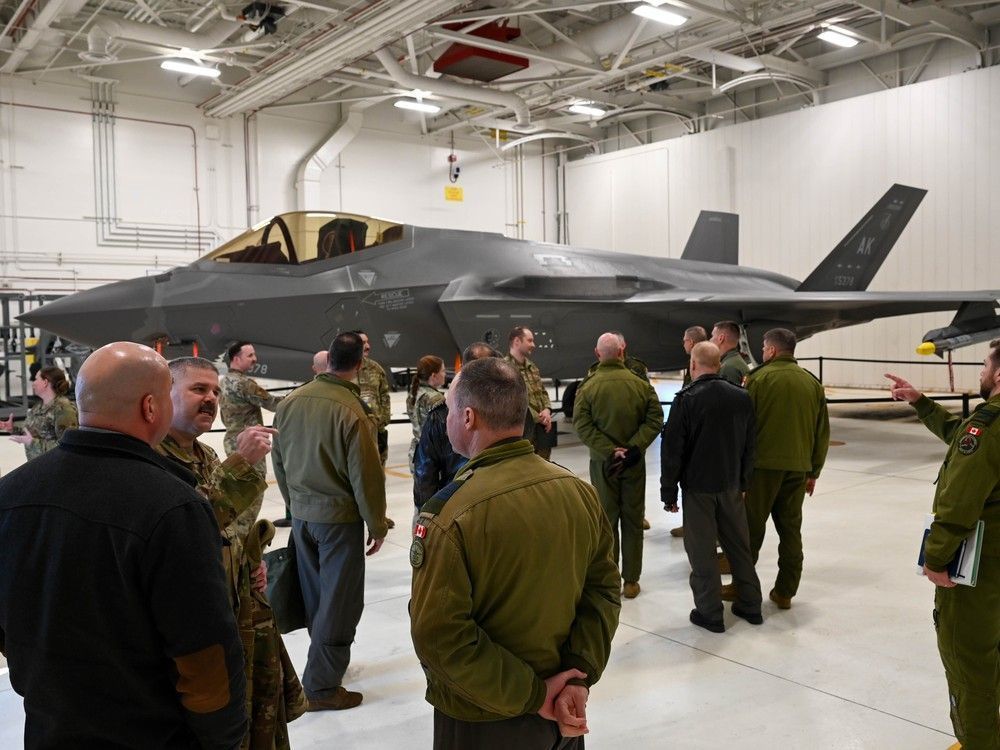
Spare parts for Canada’s new F-35 fighter jets will be stored at bases in Quebec and Alberta but such components will be owned and controlled by the U.S. government.
The little-known arrangement illustrates the extent of the control the U.S. retains over F-35s even when they are purchased by other nations.
Lawmakers in Denmark faced the spare parts issue in March when the U.S. government took components stored in that country for Danish F-35s and shipped them to Israel, reported Berlingske, a Danish national newspaper. The Danish government acknowledged it had no way to block the U.S. decision, which violated the country’s foreign policy for the region.
At the same time, U.S. President Donald Trump was talking about seizing Greenland from Denmark, sparking concern about the vulnerability of the F-35.
Canadian Forces leadership hasn’t made details of the spare parts provision public.
But a U.S. Government Accountability Office report in 2023 revealed the rules governing the F-35 parts. The report noted that the parts are the property of the U.S. government until they are installed on another nation’s aircraft.
Department of National Defence spokesperson Andrée-Anne Poulin noted in an email that F-35 spare parts are centrally managed by the U.S. “for the benefit of all customers.”
Canada will own the parts but only once they are installed on Canadian F-35s, she confirmed.
“When pooled sustainment spares are incorporated into an F-35 air vehicle or other end item, title to the spare transfers to the participant who has title to the air vehicle or end item,” she added in an email.
Spare parts will be stored principally at bases in Cold Lake, Alta., and Bagotville, Que., in dedicated warehouses, Poulin said.
DND and the Canadian Forces did not answer whether it has examined if the spare parts issue compromises Canadian national security or operational effectiveness.
Prime Minister Mark Carney has ordered a review of Canada’s $19-billion F-35 purchase in the wake of threats against Canadian sovereignty by Trump. The U.S. has become increasingly hostile to Canada, with the American president threatening to damage the economy and make this country into the 51st state.
At this point, Canada has only financially committed to purchasing the first 16 jets. The entire order was for 88 F-35s, which are manufactured by Lockheed Martin.
Critics have pointed out that the U.S. also controls all aspects of software upgrades needed for the F-35 to continue flying.
The Canadian Forces and DND are examining whether the remaining 72 F-35s should be bought but it is expected they will recommend to Carney that the acquisition proceed as planned.
Carney’s government hopes to bring in a policy which emphasizes defence purchases from Canadian firms as well as European countries. European defence firms say they could offer Canada fighter jets to replace the F-35. At least one has proposed previously to build the planes in Canada.
A number of Canadian defence industry executives have complained that Canadian military leaders appear tone deaf to the threat that Trump poses to the country. They have called for the Canadian Forces to acquire more equipment from Canadian sources.
In addition, the air force general who recommended Canada buy the F-35 fighter jet now says the purchase should no longer go forward as planned because the U.S. has become so untrustworthy.
Retired Lt.-Gen. Yvan Blondin, who headed the Royal Canadian Air Force from 2012 to 2015, argued that the American-built F-35 was the best fighter jet for Canada to operate in a world where alliances were anchored by the United States.
But all that has changed with Trump’s election and his policies.
“Reliance on a U.S. defence umbrella, a critical factor since the end of WW2 for so many countries, is no longer guaranteed,” Blondin, a former fighter pilot wrote in a March 25 post on LinkedIn. “No affected country can afford to close its eyes and hope that 2026 or 2028 elections in the US will bring everything back to ‘normal’… and not happen again. The toothpaste cannot go back in the tube.”
In March, the chairman of Denmark’s parliamentary defence committee said he regretted his role in choosing the F-35 for his country.
“As one of the decision-makers behind Denmark’s purchase of F-35s, I regret it,” Rasmus Jarlov, MP for the Conservative People’s Party wrote on social media.
He warned that the U.S. could undercut Denmark’s use of the F-35 as well as its overall defence by putting a halt to spare parts. “I can easily imagine a situation where the USA will demand Greenland from Denmark and will threaten to deactivate our weapons and let Russia attack us when we refuse,” wrote Jarlov.