
 Adedokun Waliyu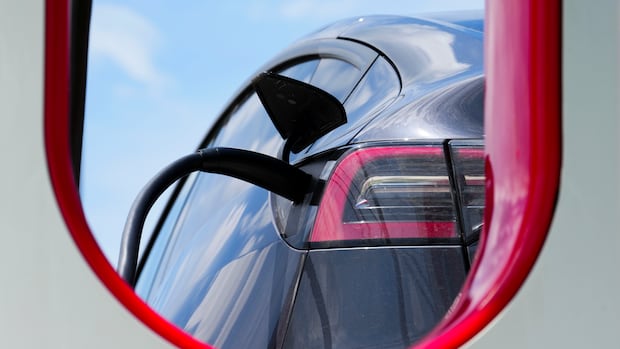
The federal government plans to expand electric vehicle (EV) charging infrastructure across Canada as part of its new automotive strategy, though the effort still falls short of what experts say is needed to support a full transition to electric vehicles.
Energy Minister Tim Hodgson said on Tuesday that Ottawa intends to spend more than $84.4 million to add 8,000 new electric vehicle charging ports to the country’s existing network of over 30,000 chargers. No specific timeline was provided for when the new ports will be installed, and it remains unclear whether the federal government will cover the full cost of the 122 charging projects or only part of it.
Hodgson made the announcement on Parliament Hill alongside Environment Minister Julie Dabrusin and Transport Minister Steve MacKinnon. The ministers took only a limited number of questions, and Hodgson’s office later said he was unavailable for further clarification.
“Many Canadians want to choose cleaner options, but they feel like EVs are too expensive, or they worry about not having enough charge to get where they need to go,” Hodgson said.
In addition to charging infrastructure, the government committed $7.2 million to 30 public awareness campaigns related to electric vehicles and $5.7 million to three projects aimed at helping Canadian freight companies purchase low-carbon vehicles.
Joanna Kyriazis, director of policy and strategy at Clean Energy Canada, welcomed the announcement, describing it as a strong signal of federal commitment.
“It’s excellent to see the federal government continue the momentum that was created last week with the auto strategy. It’s like doubling down on Canada’s EV future,” she said.
Kyriazis added that access to public charging remains critical to supporting EV adoption and building a strong domestic market.
A 2021 analysis commissioned by Natural Resources Canada estimated that Canada would need 52,000 chargers by the end of 2025 and about 447,000 by 2035. Current Natural Resources Canada data shows there are more than 38,000 public chargers across nearly 14,500 locations nationwide.
The pace of charger installation slowed in the past year, with 6,170 ports built, compared to more than 7,000 annually in both 2023 and 2024. Kyriazis attributed the slowdown partly to uncertainty created when the federal government paused its electric vehicle sales mandate.
“We didn’t know what direction the government was taking on EVs, and the sector got spooked,” she said, adding that renewed policy clarity could quickly restore investment momentum.
Charging infrastructure remains unevenly distributed across the country. Ontario and Quebec account for 67 per cent of all charging ports, British Columbia holds about 20 per cent, and Alberta has roughly five per cent.
Prime Minister Mark Carney announced last week that Ottawa would invest $1.5 billion in EV infrastructure as part of broader changes to the federal auto strategy. That plan also includes the return of an EV rebate program offering up to $5,000 for fully electric vehicles and $2,500 for plug-in hybrids, with rebates gradually reduced each year until 2030.
Carney also confirmed the end of the federal EV sales mandate, replacing it with stricter emissions standards for the auto sector.