

India Wins Cricket’s Asia Cup But Returns Home Without The Shiny Championship Hardware
 Adedokun Waliyu
4 min read
Adedokun Waliyu
4 min read
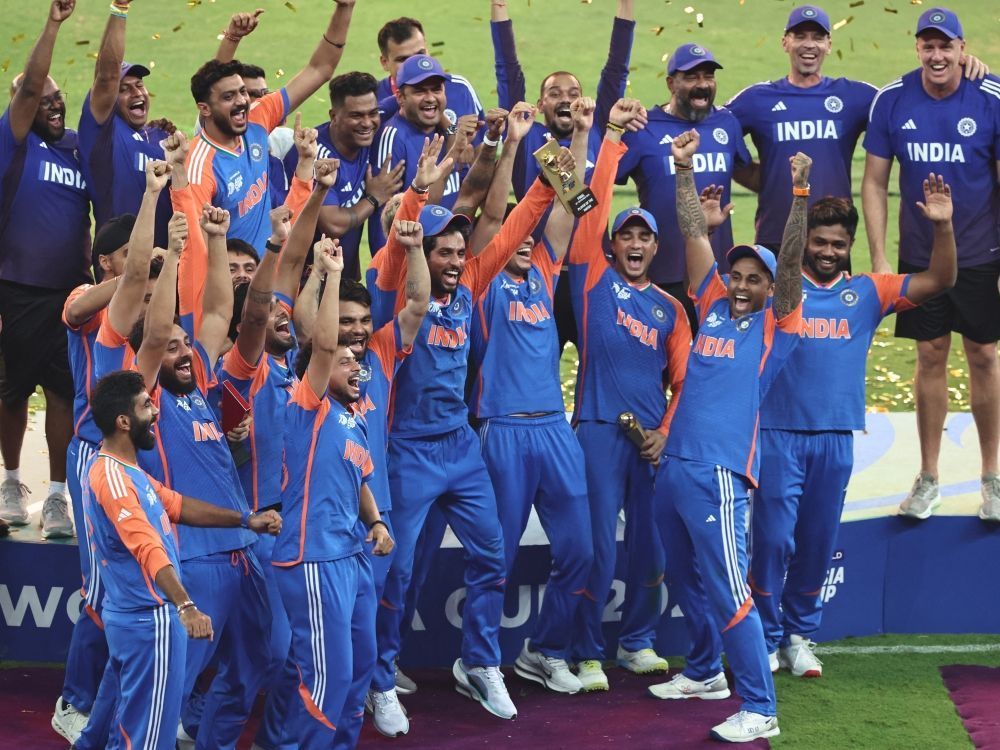
India’s captain Suryakumar Yadav (2R) playfully pretends to hold up the trophy as his team celebrates their victory at the end of the Asia Cup 2025 Twenty20 international cricket final.
India’s captain Suryakumar Yadav (2R) playfully pretends to hold up the trophy as his team celebrates their victory at the end of the Asia Cup 2025 Twenty20 international cricket final. Getty Images
India defeated arch-rival Pakistan by five wickets in an exciting and tense Asia Cup final in Dubai.
Even after bagging its ninth Asia Cup, the shining golden trophy that was proudly displayed at the stadium remained out of skipper Sureshkumar Yadav’s hands as he returned home with his squad.
This tournament involving the best nations in Asia will go down in history as nothing short of a disgrace thanks to a decision by one country to mix politics with sport. This eight-nation competition was the first time the warring neighbours — India and Pakistan — faced each other on the field after the two nuclear-armed nations engaged in a four-day military conflict in April, following a deadly militant attack on tourists in India-administered Kashmir.
Few expected that this particular skirmish would spill over in such a massive and unexpected role in the city built on sand.
Prior to the tournament, India made noise about not wanting to play Pakistan, but eventually relented and the organizers breathed a sigh of relief.
But little did they know that India’s players were instructed not to shake hands with their opposite numbers decked out in the green uniforms. In Dubai, these two Asian heavyweights met on three occasions — twice in preliminary rounds and later for all the marbles in the final.
India clobbered Pakistan in the first two encounters before the finale that turned out to be a close and exciting affair. Tensions boiled over in the second contest with Pakistan’s Haris Rauf and Shaheen Shah Afridi coming face to face with India’s Abhishek Sharma and Shubman Gill.
Both Rauf and India skipper Yadav were fined 30% of their match fees for their involvement.
Prior to the final, skipper Yadav stirred the pot by instructing the press not to refer to matches between the two countries as a “rivalry” as India had won the previous seven or eight previous encounters. He was right, of course, as India continued its supremacy in Dubai.
No handshakes by India when playing Pakistan garnered more headlines than some of the matches before the non-trophy presentation stole the show.
As per time-honoured regulations, the presentation of the trophy is usually made by the president of the particular association. In this case, it happened to be Asian Cricket Council president Mohsin Naqvi — a Pakistani who also doubles as that country’s interior minister.
India told a few officials that if it did win the final, it would not accept the trophy from Naqvi.
Naqvi refused to step aside, insisting that he alone had the prerogative of presenting the trophy and this was certainly within his rights. So, the tug-of-war between the Indians and the president continued before Naqvi ordered the trophy and the medals for the winners be whisked off the table and taken to his room.
But India’s top players in the tournament though were honoured. Batsman Tilak Varma (69 not out) and spinner Kuldeep Yadav (four for 30) starred in the final while Abhishek Sharma was named player of the tournament with his 314 runs in seven knocks.
They received their hardware from sponsors while Pakistan collected their runners-up medals from Aminul Islam, the Bangladesh Cricket Board president.
Pakistan was dismissed for 146 and India reached its target with two balls to spare with Faheem Ashraf taking three for 29. Pakistan got off to a flyer with openers Sahibzada Farhan slamming 57 and Fakhar Zaman hitting 46.
Pakistan then crashed, sliding down from 113 for two to 146, losing its last nine wickets for a meagre 33 runs.
Maybe Pakistan will have to take a close look at New Zealand coach Mike Hesson’s decision to drop two if the country’s experienced batsmen, Mohammed Rizwan and Babar Azam. The middle-order lacked experience and India’s world-class bowlers cashed in big time.
India’s captain Suryakumar Yadav reacts after playing a shot during the Asia Cup 2025 Super Four Twenty20 international against Pakistan.
Retired umpire Dickie Bird rings the five minute bell during play on the first day of the first cricket Test match between England and New Zealand at Lord’s cricket ground in London on May 21, 2015.
At the press conference, Pakistan captain Agha criticized the Indian team for what he called their “disappointing” behaviour during the Asia Cup.
“What India has done in this tournament is very disappointing,” Agha said. “They’re not disrespecting us by not shaking hands, they’re disrespecting cricket. Good teams don’t do what they did. We went to pose with the trophy on our own because we wanted to fulfill our obligations. I don’t want to use harsh words but they’ve been very disrespectful.”
India celebrated its victory by hoisting an imaginary trophy.
“I think this is one thing which I’ve never seen since I started playing cricket and started following cricket, that a champion team is denied a trophy, and that too a hard-earned one,” Suryakumar told reporters.
He then went on to dedicate the victory to his country’s armed forces, adding his winnings will also go to the forces.
It is unfortunate when a team believes it is bigger than the sport..
Former India international Suresh Raina will suit up for Toronto Sixers in the inaugural Canada Super 60 that will be played at BC Place from Oct. 8 to Oct. 13. Raina was known for his explosive batting and brilliant fielding and his participation is expected to draw big crowds.