
 Adedokun Waliyu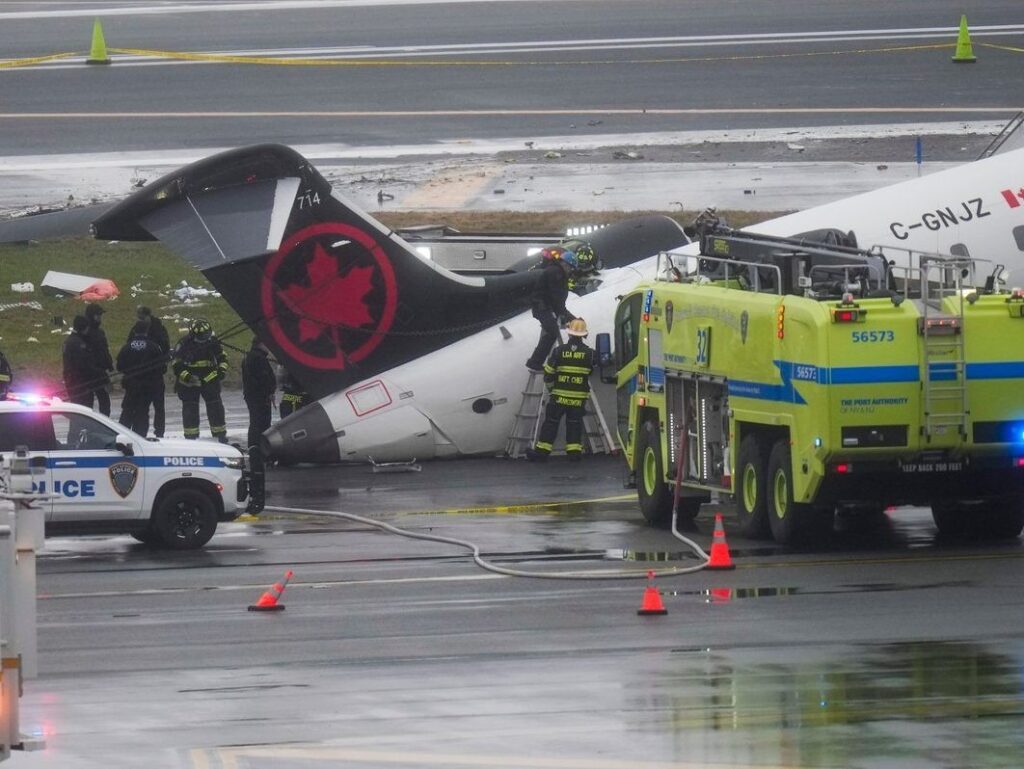
A summary of the final three minutes of Jazz flight 8646 — documented by the cockpit voice recorder (CVR) pulled from the plane’s wreckage — shows the ill-fated crew had mere seconds to react after the tower controller cleared an airport fire truck to cross in front of the landing aircraft.
According to a summary provided to reporters during a Tuesday afternoon news conference, flight 8646 was cleared to land on Runway 04 roughly two minutes and 17 seconds before the collision, instructed by the tower controller that they were second in line to touch down.
At one minute and 26 seconds, the aircraft’s radar altimeter is heard reporting the aircraft’s altitude as 1,000 feet — standard for most routine landings — followed 14 seconds later by the two Air Canada pilots, identified as Capt. Mackenzie Gunther and First Officer Antoine Forest, completing their pre-landing checklist.
Forest, said National Transportation Safety Board Chief Investigator Doug Brazy, was in control of the plane during the landing.
Fire truck cleared to cross runway 20 seconds before crash
At one minute before the collision, the CVR recorded audio of an airport vehicle attempting to contact the tower by radio, but that transmission was “stepped on” — a phenomenon caused when two radios attempt to transmit at the same time, rendering the message unreadable.
By then, Jazz Flight 8646 was at 500 feet on a stable approach.
At 45 seconds, the controller attempted to find out which vehicle tried contacting them, followed by a transmission from airport fire truck one, requesting to cross runway 04 to attend an unrelated emergency.
The tower controller granted truck one to cross the runway, just 20 seconds before the crash and while flight 8646 was 100 feet in the air.
Nine seconds before the crash, the tower controller told truck one to stop, one second before the CVR recorded sounds consistent with the aircraft’s landing gear touching down.
Gunther took control of the aircraft from Forest six seconds before the collision, followed two seconds later by another radio call from the tower instructing truck one to stop.
Two air traffic controllers were in LaGuardia’s tower at time of crash: NTSB
How many certified controllers were on site during the crash is also being investigated, said NTSB chair Jennifer Homendy — indicating the tower controller on duty Sunday evening would be interviewed at 4 p.m. on Tuesday.
“We have seen different information about how many certified professional controllers were in the facility, and we need to verify that,” she said, indicating that interviews are planned to begin later on Tuesday. “We do however know there were two people in the tower cab at the time of the collision — the local controller, and the controller-in-charge.”
The local, or tower, controller, she said, manages active runways and the immediate airspace surrounding the airport.
The tower controller, she said, signed into work at 10:45 p.m. Sunday — a little under an hour before Sunday’s crash — and was scheduled to work until 6:45 a.m. Monday morning.
“That doesn’t mean he was at his position at 10:45, but that he had just signed in at 10:45 p.m.,” Homendy said.
The controller-in-charge, Homendy said, is responsible for ensuring overall safety, but on the night of the crash was doubling at the clearance delivery controller — responsible for issuing initial clearances to aircraft before taxiing to the runway.
Fatigue an NTSB concern for overnight shifts
Movement of aircraft and ground vehicles in and around airports is handled by a team of air traffic controllers.
Tower controllers are responsible for all movements on runways, as well as all immediately arriving and departing aircraft.
Once landed, aircraft are handed off to ground controllers, who coordinate planes’ movement between runways and the terminal — as well as ground vehicles such as towing tugs, service trucks, airport staff and emergency vehicles.
Who was manning the ground controller position, Homendy said, isn’t clear at this point.
“We have some information saying it was the controller-in-charge, we have some information saying it was the local controller,” she said.
Combining controller positions, she said, is standard operating procedure at LaGuardia for the overnight shift.
“It’s also common practice across the national airspace, where you would have two controller in the tower cab during the midnight shift,” she said, adding the NTSB has repeatedly issued warnings about controller fatigue during overnight shifts.
Early analysis also suggests that LaGuardia’s ASDE-X (Airport Surface Detection Equipment, model X) surveillance equipment, which provides controllers with vehicle and aircraft positions on the ground, did not alert controllers to the conflict.
“ASDE-X did not generate an alert due to the close proximity of vehicles merging and unmerging near the runway, resulting in the inability to create a track of high confidence,” Homedy said, reading directly from the system’s analysis summary.
The truck wasn’t equipped with an ADS-B (Automatic Dependent Surveillance–Broadcast) transponder, which provides GPS coordinates of so-equipped vehicles and aircraft.
Homendy also said there’s evidence the runway status lights — ground-mounted lamps that light when a runway is occupied and not safe to enter — were operating normally, but that is subject to verification.
“We rarely, if ever, investigate a major accident where it was one failure,” she said.
“Our aviation system is incredibly safe because there are multiple layers of defence built-in to prevent an accident, so when something goes wrong, that means many, many things went wrong.”
Operational tempo at LaGuardia sparks concern among pilots
On Tuesday, U.S. media outlets reported on concerns raised by other pilots about safety issues at LaGuardia Airport, including two years of incidents and reports unearthed by CNN.
One report has a pilot lamenting about how unsustainably busy the Big Apple airport is becoming.
“The pace of operations is building in LGA, the controllers are pushing the line,” one pilot reported to NASA’s ASRS (Aviation Safety Reporting Program), according to CNN.
“On thunderstorm days, LGA is starting to feel like DCA (Ronald Reagan National Airport in Washington, D.C.) did before the accident there.”
The pilot is referring to the Jan. 29, 2025, mid-air collision between an American Airlines CRJ700 and a U.S. Army UH-60 Blackhawk helicopter over the Potomac River that killed 67 people.
Sunday’s collision occurred just five months after two regional jets, both operated by Delta-owned Endeavour Air, collided on a taxiway at LaGuardia.
Both planes sustained damage, and one of the plane’s crew members was sent to hospital with injuries.
That came just three months after a scary close-call in May 2025, where a LaGuardia air traffic controller gave takeoff clearance to a Republic Airways airliner while a United Airlines plane was still on the runway.
In that near-miss, the Republic Airways jet was forced to abort its takeoff — described in news coverage as a “chaotic communication breakdown.”
Nobody was injured in that case.
Plane vs. vehicle collisions a concern, says aviation attorney
Aviation Attorney Robert A. Clifford, founder and senior partner of Clifford Law Office, said that while the NTSB continue their investigation, it does appear Sunday’s collision apparently came as a result of an error by the LaGuardia tower controller.
“This preliminary information at the very least highlights the continuing need for better and safer ATC and ground vehicle control systems and protocols to assure the safe movement of ARFF vehicles on airport surfaces,” he said.
“The FAA and others in the aviation industry must learn from these mistakes and develop better and more redundant means of preventing these ground accidents, especially late at night when visibility, fatigue, and other human performance issues may reduce safety.”
This isn’t the first crash involving aircraft and ground vehicles, Clifford said — pointing to the 1984 collision of an Aeroflot plane and maintenance vehicles on the runway at Omsk airport in the former Soviet Union, killing 178 people, and the Nov. 2022 death of two airport firefighters in Lima, Peru, after a LATAM Airbus collided with their fire truck while taking off.