
 Adedokun Waliyu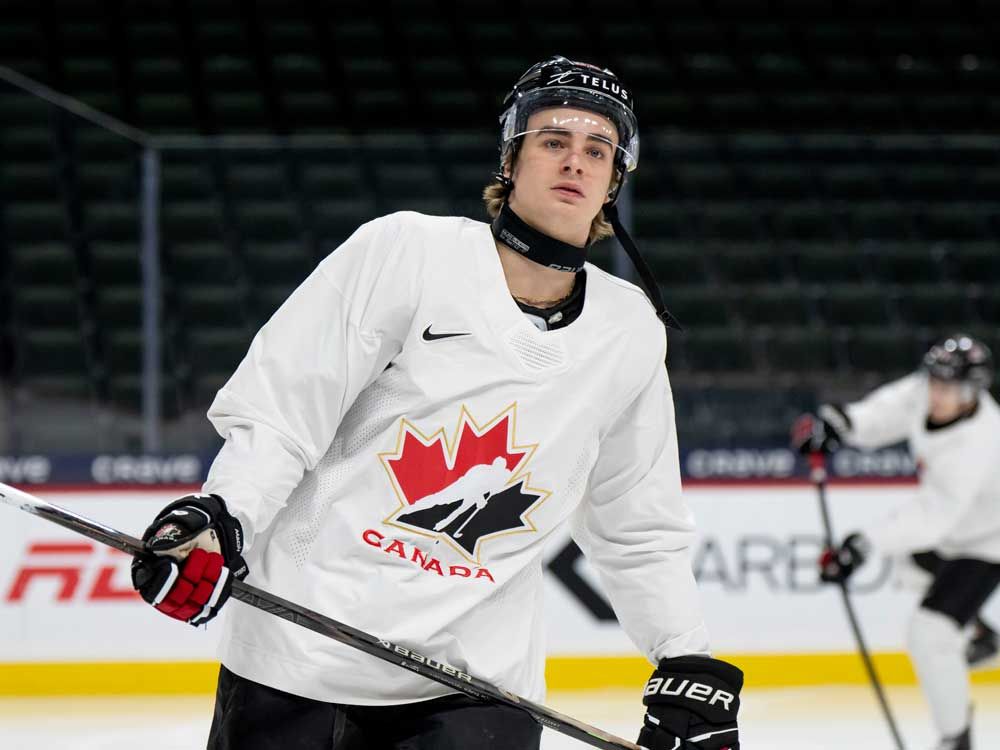
Porter Martone’s name has followed Canada into the semifinal.
Not least because of what happened after the captain’s empty-netter against Czechia on Boxing Day, when a moment of emotion turned a preliminary-round win into a talking point the Canadians would rather have avoided.
Canada beat Czechia 7-5 in one of the most entertaining games of the tournament, a wide-open, back-and-forth affair that never felt settled.
But the game ended without a handshake line, and with Martone issuing a public apology the next day after he patted Czechia’s Adam Novotny on the rear end following his empty-net goal.
Days later, with a ticket to the gold medal game now on the line, that incident sits quietly in the background as Canada prepares to face Czechia again after a dominant 7-1 quarterfinal win over Slovakia.
Asked about Czechia, Martone kept the focus on preparation, stressing discipline and execution rather than emotion. He also acknowledged that Czechia commands respect.
“They’re a really good hockey country,” Martone said. “They’ve grown over the years, and they have a really good hockey team. For us, it’s just focusing on ourselves, what we can do to bring our best ability and how we prepare.”
Martone, who has recorded four goals and seven points in five outings, expects a game that mirrors the intensity of recent Canada-Czechia clashes.
“It’s going to be hard, fast, skilled,” he said. “We’ve just got to stick to our identity, stick to our structure, and do what (coach) Dale (Hunter) is telling us.”
Czechia a relentless opponent
Recent history hasn’t favoured Canada in elimination games. Since winning gold against Czechia in Halifax in 2023, it’s been the Czechs who’ve ended Canada’s last two world junior tournaments — both in the quarterfinals.
Czechia hasn’t won gold since 2001, but it has medalled in three straight years, and it’s once again affirmed its reputation as a relentless, wave-after-wave opponent that forces mistakes through pace and pressure.
Managing emotion may be the biggest challenge for Canada. Martone said his team can’t afford to give the Czechs any advantages.
“Play with emotion. Play with all the heart you have,” he said. “But you have to be emotional at times and not take those bad penalties.”
Canada has performed admirably in that department, committing the second-fewest penalties in the tournament to this point.
That balance will be tested against a Czech team built to pester. They push pace from the opening faceoff, average among the tournament’s highest shot totals, and bring a blue line that blends size and mobility — 6-foot-6 Radim Mrtka and 6-foot-5 Max Psenicka chief among them.
Canada playing well
“They’re a good team,” Hockey Canada general manager Alan Millar said. “Big, heavy, structured. Their back end is very mobile, and we’re going to have to be at our best.”
Canada’s confidence comes from its depth and from signs that it’s peaking at the right time. The forward group leads the tournament in scoring and power-play efficiency, while the third line of Cole Beaudoin, Caleb Desnoyers and Sam O’Reilly has quietly become a defensive anchor at even strength.
On the blue line, Zayne Parekh enters the semifinal as the tournament’s leading scorer, a constant offensive driver whose puck movement has fuelled Canada’s transition game.
“He’s always making plays,” Martone said of Parekh. “He really helps get things started from the back end. On the power play, he’s very good with the puck and always knows what to do.”
Parekh is within two points of Alex Pietrangelo for the most points by a Canadian defenceman in a single world juniors.
In goal, Jack Ivankovic is expected to start again after posting a tournament-leading .959 save percentage through two starts.
“He knows how to slow the game down,” Martone said. “Especially when things get tense. He’s very good under pressure.”
Cole Beaudoin sees it the same way.
“He’s calm, he’s poised,” Beaudoin said. “You see why he’s won so much with Hockey Canada. He’s a great goalie and a great person off the ice.”
The University of Michigan freshman’s international resume includes gold medals at the Canada winter games, the Hlinka-Gretzky Cup, the U17 world challenge, and two under-18 world championships.
Last year’s quarterfinal loss still lingers for Beaudoin, one of six returnees this tournament. But he said it’s no longer something to react to.
“It’s a new year,” Beaudoin said. “We won’t think about the past too much, but we’ll definitely use it as f