 Adedokun Waliyu
Quebec’s policy banning religious symbols for public servants has been upheld.
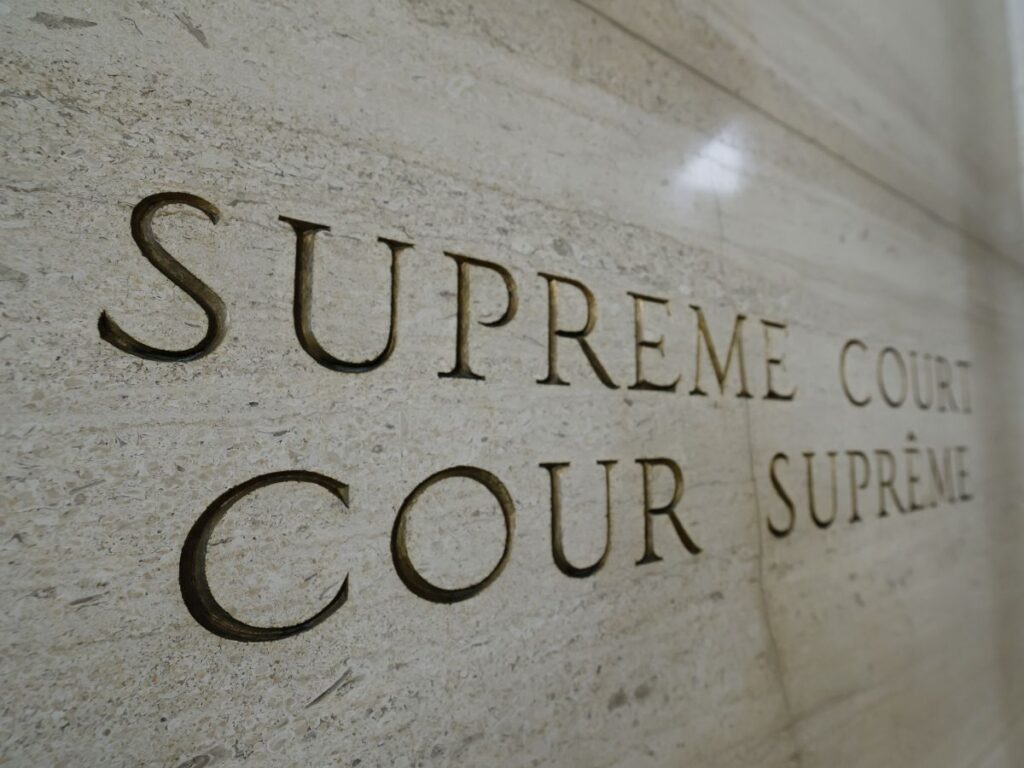
In a decision released on Friday, the Supreme Court of Canada largely upheld the province’s contentious law and declined to erect new limits on the Constitution’s notwithstanding clause.
The decision, which saw Canada’s highest court dismiss appeals as well as Quebec’s cross-appeal, upheld most of Quebec’s Bill 21 — An Act respecting the laicity of the State — except for provisions banning face coverings for members of the National Assembly, which the court found unconstitutional.
The law survived by a single vote — three of the court’s seven judges said they would’ve struck down Bill 21’s core provisions under the Charter’s guarantee of equality between the sexes, which they argued is beyond the scope of the notwithstanding clause.
As it stands now, the result leaves teachers, judges and police officers in the province barred from wearing religious symbols such as hijabs, turbans, kippahs and crosses while on the job.
Chief Justice Richard Wagner, writing for three of the top court’s judges, ruled that the notwithstanding clause “imposes only formal requirements” on legislatures, while leaving courts no role in second-guessing its use.
Passed in June 2019, Bill 21 was the target of scrutiny and challenges almost immediately after it became law.
Challengers included civil liberties groups, organizations representing Muslims and Sikhs, a teachers’ union and the English Montreal School Board.
After surviving challenges in Quebec Superior Court and the Quebec Court of Appeal, Bill 21 was headed to the Supreme Court, which agreed to hear appeals in January 2025.
Section 33 of the Charter, also known as the notwithstanding clause, lets Parliament or provincial legislatures shield a law from court challenges over certain Charter rights.
The decision is a marked setback for Ottawa, which had urged the Supreme Court to limit how the clause is used by provinces.
Four of the top court’s judges, however, ruled Canadian courts can still declare “shielded” laws in violation of the Charter — even though no such declaration was issued against Bill 21.
“This Court should not be silent when asked by claimants to acknowledge that the Act infringes their rights and freedoms,” Justices Andromache Karakatsanis and Michelle O’Bonsawin wrote in the decision.
Numerous groups expressed dismay with the decision.
Danish Singh, president of the World Sikh Organization of Canada (WSO), said the top court’s decision hurts the province’s Sikh community.
“Sikh Quebecers have been denied careers in public service because of their faith. Amrit Kaur wanted to teach in the community that raised her. Quebec’s Bill 21 drove her out,” he said in a statement, referring to the Sikh schoolteacher who was forced to move from Quebec to British Columbia because Bill 21 prevented her from wearing a headcovering in class.
“We have heard from Sikh youth who are afraid to go out because of harassment, workers pressured to remove their dastaars (turbans) even in workplaces outside the scope of Bill 21, and parents turned away from volunteering at their children’s schools.”
Referencing a recent WSO survey, Singh said nearly nine in ten French-speaking Sikh respondents in Quebec reported anti-Sikh hate.
Coalition Inclusion Quebec, an alliance of members of the province’s Christian, Jewish, Muslim, Sikh and other communities, likewise criticized the decision.
“What kind of society does Quebec want to be?” the group said in a statement.
“Will it be the inclusive, welcoming society that guarantees to each person the minimum conditions for the exercise of their freedoms of which Rene Levesque was so proud in 1985, or will it place minorities at the mercy of the shifting moods of the majority?”
With the Supreme Court rendering its decision, the coalition says it’s now up to the people of Quebec to “uphold our fundamental rights and freedoms” and ask the provincial government to respect Quebec’s “historic commitment to justice, equality, and human dignity.”
In a statement, City of Brampton Mayor Patrick Brown said the decision left him “deeply disappointed,” and that no court ruling changes the fact that Bill 21 is discriminatory.
“This decision sets a precedent that affects all Canadians, not just those in Quebec,” he said.
“It means a government can tell a teacher in a turban, a police officer in a hijab or a lawyer wearing a kippah that their faith disqualifies them from public service. Canadians should not accept that.”
Brampton was the first Canadian municipality to formally support the Bill 21 legal challenge.
“I call on federal leaders of all parties to defend the Charter rights of every Canadian,” Brown said.
“A court ruling may settle the law, but it does not settle what is right.”