 Adedokun Waliyu
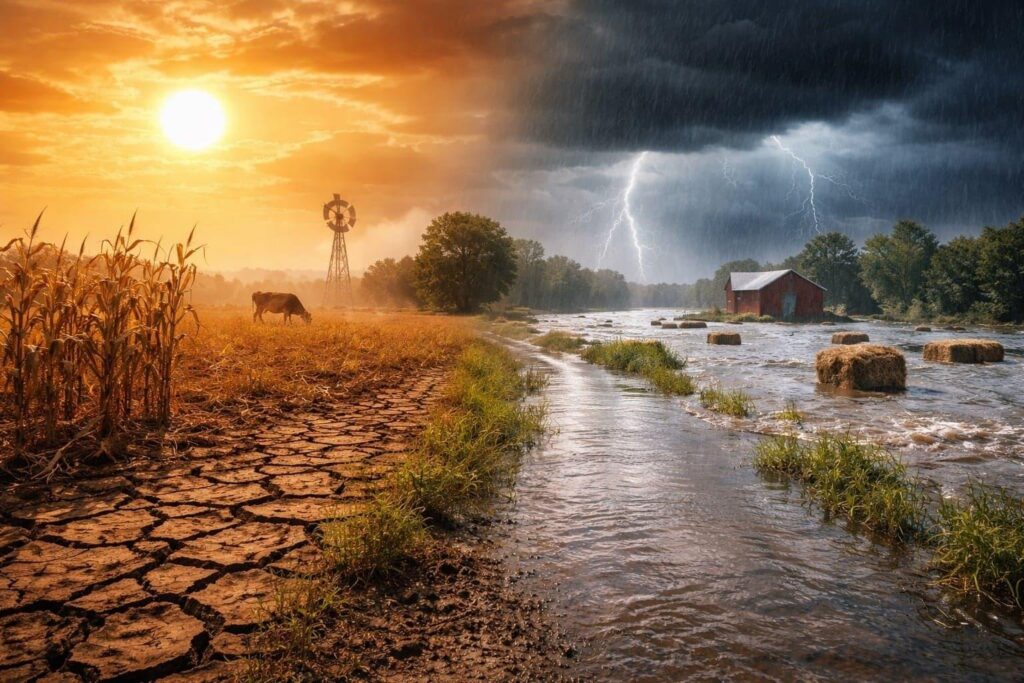
The El Niño weather phenomenon, expected to be exceptionally strong this year, could worsen disruptions to the global economy, leading to higher food and electricity prices.
El Niño is a naturally occurring climate phenomenon involving the warming of surface temperatures in the central and eastern equatorial Pacific Ocean. It has already altered wind and rainfall patterns around the world, causing devastating droughts and wildfires.
Combined with climate change and rising energy and commodity prices linked to the United States’ war against Iran, the potential economic damage is significant.
“In general, you can say it’s an extreme negative supply shock,” Paolo Zanghieri, an economist at Generali Asset Management, told AFP.
Agriculture, trade and hydroelectric power production are expected to experience the most immediate effects. El Niño is projected to peak in December and last at least until March, with its consequences likely to continue for several months afterwards.
Oxford Economics estimates that if the phenomenon becomes as severe as many experts predict, global Gross Domestic Product (GDP) could fall by 0.6 per cent next year and a further 0.8 per cent in 2028.
Inflation Pressures
Poor harvests caused by excessive heat or rainfall could push food prices higher, placing additional pressure on millions of people in developing countries, where food accounts for a larger share of household spending.
Zanghieri and his colleague, Guillaume Tresca, an emerging markets strategist, warned in a recent report that a 2°C rise in Pacific Ocean temperatures associated with El Niño could increase global food prices by as much as 20 per cent by the first quarter of 2028.
They estimated that this could raise overall inflation in the United States and the eurozone by 0.4 percentage points, while developing countries could experience an additional 3.0 percentage points.
“Our vulnerability index suggests that South Asia and Sub-Saharan Africa face the greatest risks,” they added.
Although moderate food price increases can sometimes be managed through additional imports, existing food reserves or alternative products, Deutsche Bank analysts warned that a widespread crisis could have more serious consequences.
“A large shock propagating across multiple countries can’t be absorbed as easily, with second-round inflation effects likely to result,” they wrote in July.
Simon Lacoume, an economist at French export credit insurance group Coface, explained that a decline in Brazil’s corn harvest, for instance, could affect livestock farming and meat production.
Droughts could also reduce water levels in reservoirs used by hydroelectric power plants, forcing countries to increase oil and gas imports at a time when energy prices are already high because of the Gulf conflict.
However, the effects can vary. Sri Lanka recently cancelled an electricity price increase after heavy El Niño-related rainfall helped replenish its reservoirs.
Hard To Measure
Droughts are also disrupting international trade by reducing traffic through the Panama Canal. Low water storage levels have forced authorities to restrict canal operations since September.
Although recent rainfall has allowed an increase in operations, the government has declared a nationwide emergency over the exceptionally strong El Niño conditions.
Central banks are also facing difficulties in assessing the economic consequences. They must balance efforts to control inflation against the risk of raising interest rates so high that they trigger an economic downturn.
“The impact is very disparate and complicated to measure,” Tresca told AFP. “It depends on when a meteorological event hits during the planting cycle, for example.”
The Organisation for Economic Co-operation and Development (OECD) has urged governments to increase investment in existing plans designed to strengthen resilience against climate change.
However, many countries have made insufficient progress in adapting their agricultural systems and infrastructure to changing climate conditions.
“We don’t see the national adaptation plans actually resulting in actual mandates for different economic actors to take on these resilience investments,” said Catherine Gamper, Team Lead for Climate Change Adaptation at the Paris-based organisation.
Even where governments are willing to act, many countries are struggling with high debt and budget deficits that have increased for various reasons in recent years.
“There is absolutely a public finance problem,” Gamper said.