 Adedokun Waliyu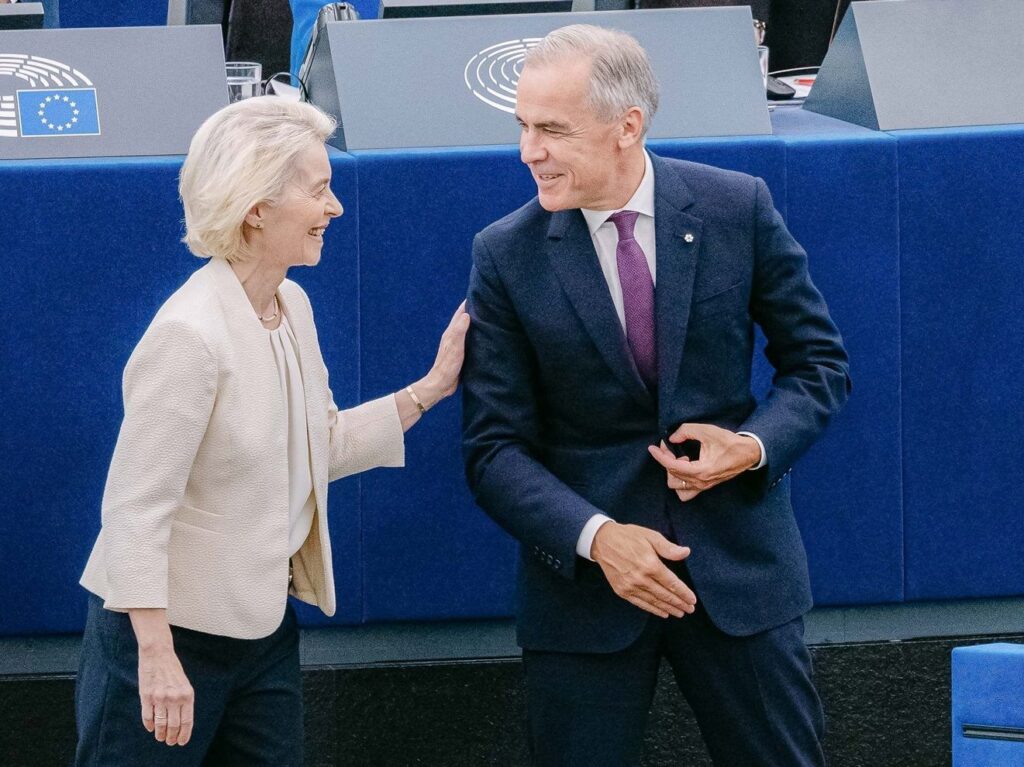
Mark Carney couldn’t stop smiling as he rose in the European Parliament, enthusiastically joining the standing ovation for Ursula von der Leyen. The president of the European Commission had just announced that she and Carney were working toward the very thing he had denied twice this week.
“Dear Mark, I said we must urgently re-imagine our partnerships. So I would like to work with you on opening the door for Canada to being the first associate member of the European Union,” von der Leyen said.
Funny thing about that: It was just this past Sunday, while reacting to a Wall Street Journal report, that Carney said this wasn’t happening. Stopped by a CBC reporter on his way into an event at the Toronto International Film Festival, the reporter asked Carney directly.
“Prime minister, the Wall Street Journal says Canada is going to become an associate member of the European Union. What do you have to say about that?” the reporter asked.
CBC didn’t publish the full exchange, but Carney was clear in the part of the response that it did publish.
“Look, we’re not looking to become a member of the European Union. What we are looking and will begin discussions for (is a) unique alliance with the European Union between Canada and the European Union,” he said.
PM Said Not To Expect ‘Big Reveal’
At his investment summit, Carney was asked what his objective was in deepening ties with Europe. He spoke about this being part of a push for sovereignty and independence, while juxtaposing the EU against the United States.
“So don’t expect it,” Carney said, “a big reveal.”
And yet a big reveal it was. So big that it caught many members of the EU off guard.
“Who has given you a democratic mandate to do that?” asked Manon Aubry, a French member of the European parliament and member of the eco-socialist party La France Insoumise.
Nicola Procaccini, a member of the right-wing populist party Brothers of Italy, asked how Canada could become an associate member of the EU when Britain has been rejected.
It’s true. Britain, after leaving the EU, has been rebuffed in its attempts to secure a deep trading relationship with the EU without having it dictate British law, which is part of the reason why they left in the first place.
The Sovereignty Paradox
It’s rather rich for Carney to say that he’s drawing closer to Europe to support Canadian independence and sovereignty when he knows that any further integration means handing over decision-making on a broad range of issues to bureaucrats in Brussels rather than elected officials in Ottawa.
We already have a free-trade deal with the EU. We are a founding member of NATO, a defence organization that covers most members of the EU.
Any further integration will require following EU laws and regulations rather than our own. This isn’t speculation. We just need to look at the agreements the EU has with Switzerland or the European Economic Area that includes the non-EU nations of Iceland, Liechtenstein and Norway.
To gain the kind of deep market access that Carney is seeking, Norway and other associated countries had to accept EU control over product standards, food safety, consumer protection, environmental rules and corporate law. They also had to agree to adopt much of the legislation passed by the European Parliament without having a vote on that legislation.
What’s The Real Plan?
Some of the regulatory changes could be an improvement on what we currently have. They could be worse. But the point is that they would not be our decisions.
If Carney thinks he can secure full market access with terms that Britain, Norway, Iceland and Switzerland couldn’t reach, then perhaps he’s more special than the rest of us realize.
What he should be doing is being honest with Canadians about his goals. He spent the week denying he was seeking membership, then beamed as von der Leyen announced exactly that.
If this is the future Carney wants for Canada, he should stop denying it and start defending it. Canadians deserve that much.