 Adedokun Waliyu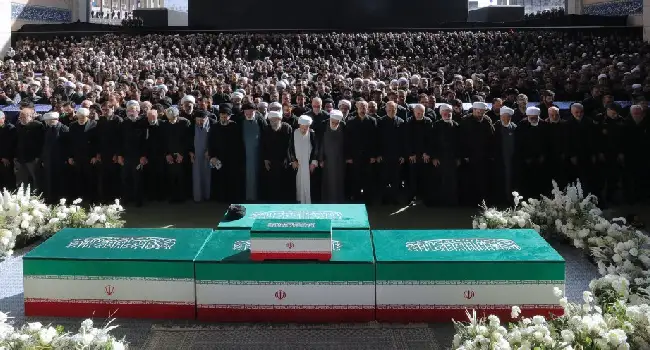
Three sons of Iran’s late Supreme Leader, Ali Khamenei, made a rare public appearance at his funeral in Tehran on Sunday, while his successor, Mojtaba Khamenei, remained absent, fuelling continued public interest over his condition.
Large crowds gathered for a second consecutive day at Tehran’s Grand Mosalla religious complex to honour Ali Khamenei and four family members who were killed in Israeli airstrikes on February 28 during the US-Israeli war with Iran. The funeral ceremonies have also become an opportunity for Iranian authorities to demonstrate resilience following the conflict, which claimed several senior leaders but did not topple the country’s political system.
Parliament Speaker Mohammad Bagher Ghalibaf praised what he described as the united support of the Iranian people, saying the massive turnout reflected national solidarity.
The funeral programme will continue with a procession in Tehran on Monday, followed by ceremonies in Qom on Tuesday and Iraq on Wednesday, before Ali Khamenei is buried in his hometown of Mashhad on Thursday.
Among those present on Sunday were Khamenei’s eldest son, Mostafa, and his younger sons, Masoud and Meysam, all of whom are clerics. However, Mojtaba Khamenei, who assumed the role of Supreme Leader after his father’s death, was not seen.
Iranian officials have stated that Mojtaba was wounded during the February 28 airstrikes, though the extent of his injuries has not been disclosed. Since assuming office, he has communicated only through written statements. His continued absence has intensified speculation, and attention is expected to focus on whether he will appear during the remaining funeral events, particularly Thursday’s burial ceremony.
Also present was the newly appointed commander of the Islamic Revolutionary Guard Corps, Ahmad Vahidi, who had remained out of public view during the war. Esmail Qaani, commander of the Quds Force, also appeared and described Ali Khamenei’s death as a “blessed end” after decades of dedication to the Islamic Republic.
The funeral prayer was led by Grand Ayatollah Jafar Sobhani before the casket was moved for Monday’s procession.
The government has highlighted the large public turnout as evidence of continued support for the Islamic Republic following widespread protests earlier in the year. Authorities expect more than 10 million people to participate in the funeral activities in Tehran and have implemented extensive security measures, including medical centres, to prevent crowd-related incidents.
Although a ceasefire and preliminary agreement with the United States have paused the recent conflict, tensions remain high. Many mourners called for justice and retaliation over Ali Khamenei’s killing.
One mourner said those responsible should face punishment, while another insisted the Iranian people continue to support the revolution and seek revenge for those who lost their lives.
Representatives of Hamas, Hezbollah, Yemen’s Houthi movement, and the Palestinian Islamic Jihad attended the funeral ceremonies and held meetings with Iranian Foreign Minister Abbas Araghchi, reaffirming Iran’s longstanding ties with allied armed groups across the Middle East.