 Adedokun Waliyu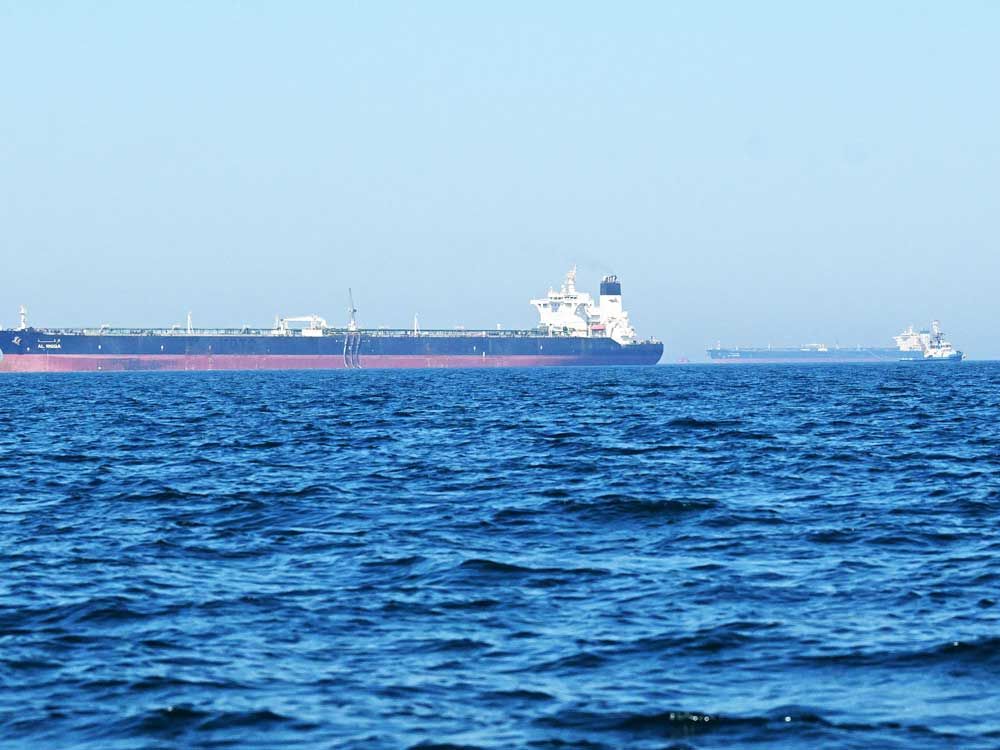
Less than two weeks after the interim peace agreement between the United States and Iran was signed, the fragile truce continued to show signs of strain as both sides exchanged strikes targeting military infrastructure overnight from Saturday into Sunday.
Tensions escalated over the weekend after the United States carried out airstrikes on Iran for a second consecutive day late Saturday, prompting Tehran to launch retaliatory attacks on U.S. forces in Bahrain and Kuwait on Sunday.
Iran’s Islamic Revolutionary Guard Corps (IRGC) said it targeted U.S. military sites at the Ali Al Salem Air Base in Kuwait and the U.S. Navy’s Fifth Fleet naval base in Salman Port, Bahrain.
Kuwait’s military said it intercepted Iranian drones and two ballistic missiles, while Bahrain’s Interior Ministry reported that strikes hit a residential building near the airport but caused no deaths.
The latest exchange of attacks followed Thursday’s incident in which Tehran struck a Singapore-flagged cargo ship in the Strait of Hormuz, leading Washington to respond with airstrikes the following day.
A 14-point memorandum of understanding signed by the United States and Iran called for both sides to suspend hostilities for 60 days and restore unrestricted shipping through the Strait of Hormuz, a vital waterway through which around 20 percent of the world’s oil supply passed before the war.
The IRGC, however, claimed that the agreement gives Iran control over shipping traffic through the strait, while both countries accused each other of violating the ceasefire agreement.
Iran’s Foreign Minister, Abbas Araghchi, said on Sunday that the “management and full reopening” of the Strait of Hormuz is Iran’s responsibility, warning that any attempt to challenge the country’s control of the strategic waterway would increase tensions in the Middle East.
Speaking at a news conference in Iraq, Araghchi urged all parties to adhere to the memorandum of understanding and not allow it to deviate from its intended course. Although the agreement called for reopening the Strait of Hormuz, both Tehran and Washington have interpreted its provisions differently regarding Iran’s authority over vessels using the route.
Iran’s attacks on Kuwait and Bahrain were condemned by both countries. Kuwait’s Ministry of Foreign Affairs described the attacks as a flagrant violation of its sovereignty and a direct threat to its security, stability, and the safety of its citizens and residents. The ministry also called the attacks a clear violation of international law and the United Nations Charter.
Bahrain’s Foreign Ministry issued a similar statement, describing the attacks as a serious threat to the security of its citizens and residents. Qatar, the United Arab Emirates, Jordan, and Oman also condemned the attacks.
Tehran accused the United States of violating the interim agreement through its latest airstrikes, saying the attacks demonstrated that Washington places no value on its commitments. The IRGC claimed responsibility for the attacks on U.S. military facilities in Bahrain and Kuwait and warned that further American strikes would result in the complete suspension of all diplomatic efforts.
The U.S. Central Command (CENTCOM) announced that U.S. Navy and Air Force fighter jets struck ten Iranian military targets in and around the Strait of Hormuz in response to Iran’s drone attack on the Panama-flagged crude oil tanker M/T Kiku.
According to CENTCOM, the targets included Iranian military surveillance infrastructure, communication systems, air defence sites, drone storage facilities, and minelayer capabilities. The command added that commercial vessel traffic through the Strait of Hormuz continues and that U.S. forces remain vigilant and prepared.
Accusing Iran of breaching the ceasefire agreement, U.S. President Donald Trump warned that further military action remained possible. He stated that if Iran continued its actions, the United States might eventually be forced to complete its military objectives, warning that the Islamic Republic of Iran would no longer exist if that occurred.