US Expands Support For Nigeria Agricultural Trade With Export Credit Guarantee Scheme
 Adedokun Waliyu
2 min read
Adedokun Waliyu
2 min read
The United States (US) says it has expanded support for agricultural trade with Nigeria through the export credit guarantee programme (GSM-102) of the US Department of Agriculture.
In a statement on Friday, the US consulate general said the programme provides credit guarantees backed by the American government and serves as an important tool for Nigerian banks and importers to use when sourcing essential agricultural inputs from the US.
The statement said the initiative is part of efforts to strengthen US-Nigeria agricultural trade, enhance food supply chains, and boost commercial opportunities for both countries.
According to the US mission, bilateral trade between the two nations reached nearly $15 billion in 2025, representing a 14 percent increase from 2024.
“Agricultural trade has been a major contributor to this expansion, increasing to $764 million—an 84 percent rise from $415 million in 2024—and underscoring Nigeria’s importance as a key partner,” the statement reads.
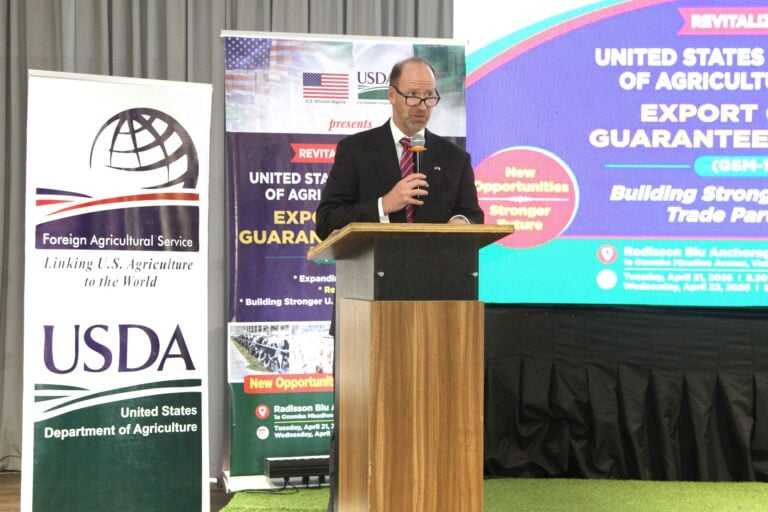
“To promote awareness and utilisation of the GSM-102 programme, the Foreign Agricultural Service of the US consulate general hosted a two-day event in Lagos, bringing together officials from the US Department of Agriculture, the US International Development Finance Corporation, the Nigerian-American Chamber of Commerce, agricultural exporters, Nigerian banks, and importers.”
Speaking at the event, Rick Swart, the US consul general, said Nigeria is one of the United States’ most important agricultural trade partners in Africa.
“Under the Trump administration, we are making a clear shift, from aid to trade,” Swart said.
“We’re engaging Nigeria as an outstanding and unique commercial partner. That means we are looking for real-world solutions that foster the kind of business environment that enables entrepreneurs, innovators, and investors to build the future of US-Nigeria commerce.”
Demeteris Hale, senior analyst for Africa and other regions at the US Department of Agriculture, said the programme reduces transaction risks and enables lenders and exporters to expand into new markets.
“We are here to work with financial institutions, importers, exporters, and other stakeholders across the industry to build stronger linkages and drive increased agricultural trade,” Hale said.
The US mission said it remains committed to expanding agricultural trade, strengthening commercial ties with Nigerian agribusinesses, supporting private sector growth, and deepening economic engagement.